Steel palisade fencing is the perimeter choice for Sydney’s warehouses, substations, correctional facilities, and government sites , but not all palisade products perform the same way. The “358” anti-climb rating appears on almost every product sheet, yet mesh sizes in the market range from under 10 mm to over 25 mm, and coating types vary widely. Here are the six most specified options, starting with the supplier th
Steel palisade fencing is the perimeter choice for Sydney’s warehouses, substations, correctional facilities, and government sites , but not all palisade products perform the same way. The “358” anti-climb rating appears on almost every product sheet, yet mesh sizes in the market range from under 10 mm to over 25 mm, and coating types vary widely. Here are the six most specified options, starting with the supplier that handles the full project scope.
1. LS Fencing, Sydney’s Tier 1 Industrial Palisade Specialists
LS Fencing is Sydney’s go-to supplier for industrial palisade fencing on government and commercial projects. Established in 2012, the company has completed installations at substations, correctional facilities, and major commercial sites, the kind of reference list that tier 1 builders and procurement officers actually care about.
Each pale is 3 mm thick steel, cold-rolled into a W-profile for stiffness, then bolted to horizontal angle rails fixed to structural-grade posts. Standard product goes through hot-dip galvanisation before it leaves the factory, which matters on coastal and semi-coastal Sydney sites where salt air accelerates bare-steel corrosion.
What separates LS Fencing from product-only suppliers is the end-to-end service model. They quote, fabricate, deliver, and install , and they work directly with specifiers to customise heights, spear profiles, and gate configurations. For government contracts and tier 1 builder programmes where accountability sits with a single sub-contractor, that matters.
One honest caveat: because LS Fencing prices each project on scope and specification rather than a published rate card, you need to request a quote. Pricing varies by height, coating, and site conditions. Visit the LS Fencing palisade fence page to see full product details and request a project-specific quote.
2. Straight Spear Top Steel Palisade, Classic High-Security Deterrent
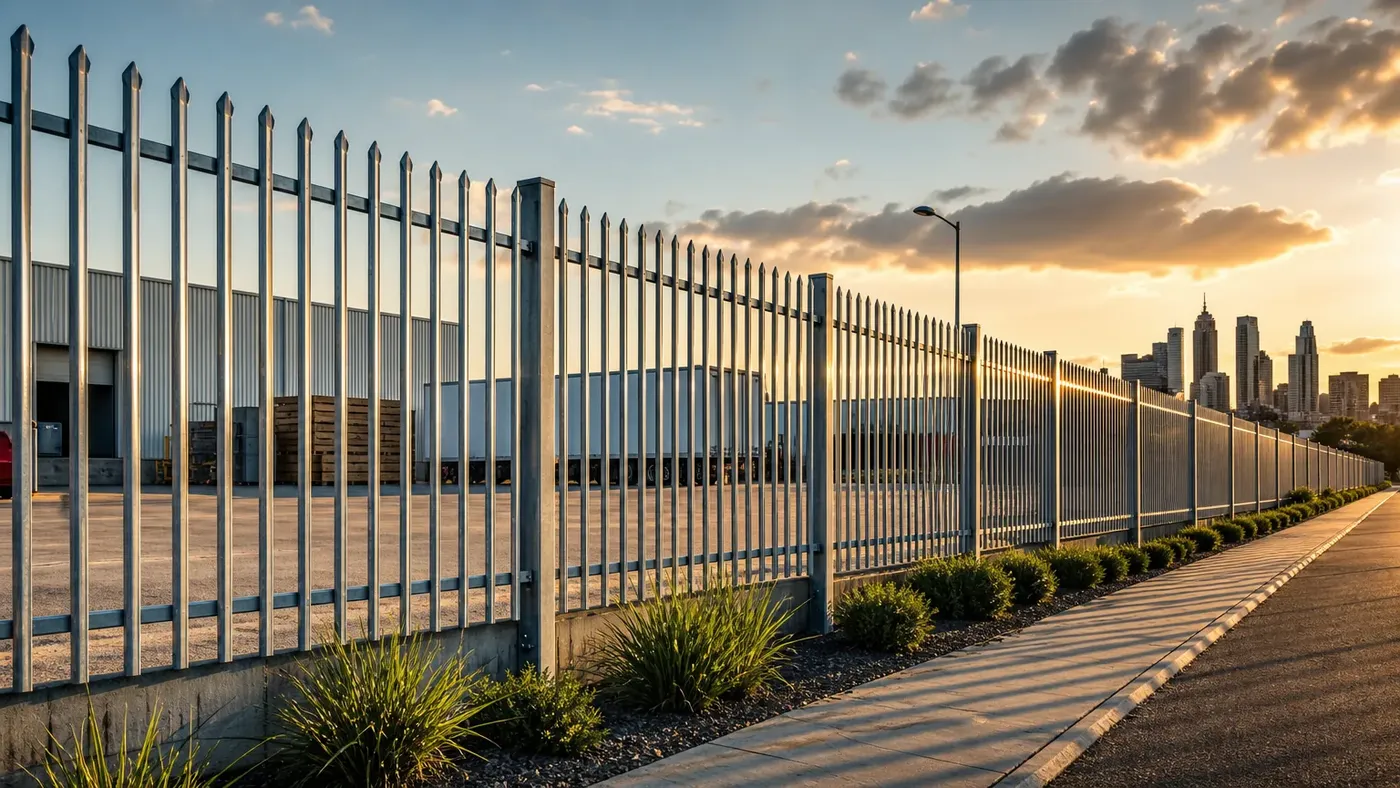
The straight spear top is the standard palisade profile specified on commercial sites across Sydney. Each pale terminates in a vertical point, making it difficult to grip or straddle. The W Pale Straight Palisade profile complies with BS1722, the British Standard for fencing that is widely referenced in Australian commercial and government security specifications.
W-profile pales in this configuration typically run at 25 mm to 75 mm pale width depending on security grade, fixed at 50 mm to 75 mm clear gaps. That gap spacing is intentional: wide enough to avoid a climbable mesh foothold, narrow enough to prevent body passage at lower heights.
This is the right product for sites that need a strong visual deterrent combined with a proven compliance record. Warehouses, distribution centres, and council infrastructure yards are typical applications. The straight spear top is also the easiest profile to source at volume, which keeps lead times manageable for large-perimeter projects.
The limitation is clear-cut: on sites assessed as extreme-risk (data centres, critical utilities, corrections), the straight spear top alone may not satisfy a formal security risk assessment. Those sites usually need a 358 mesh panel or a curved spear variant as the primary barrier, with additional topping.
3. Curved Spear Top Palisade, Enhanced Anti-Climb Protection
Curved spear tops add an outward-angled hook to the pale tip. The curve makes it significantly harder to get a grip over the top rail, which is where most climbing attempts begin. For facilities that need a step up from the straight spear without the cost and visual weight of a full 358 mesh system, this is a usable middle ground.
The pale profile is otherwise identical to a straight spear top , W-section steel, bolted to angle rails, hot-dip galvanised or powder-coated. The key difference is purely at the tip geometry. That makes curved spear top palisade compatible with the same post sizes, footings, and gate hardware as the straight version, which simplifies mixed-perimeter installations where only certain runs need the upgraded deterrence.
Facilities managers at schools, hospitals, and light industrial precincts often specify curved spear tops on pedestrian-facing runs while using straight spear tops on vehicle-side perimeters. The result is a tiered security approach that allocates budget where the risk is actually highest.
Worth noting: the curved tip adds a small premium over straight spear profiles, and not every fabricator stocks it at short lead times. Confirm availability early in the procurement process, especially on projects with fixed programme dates.
4. Hot-Dip Galvanised Steel Palisade, Built for Coastal Sydney Conditions
Hot-dip galvanisation coats every surface of the steel , inside hollow sections, around bolt holes, at cut edges , with a zinc layer that bonds metallurgically to the base metal. In Sydney’s coastal and near-coastal zones, where salt-laden air and humidity accelerate corrosion on unprotected steel, a proper hot-dip coating is the minimum acceptable specification for a fence expected to last 25 or more years without structural maintenance.
The process involves immersing fabricated steel components in a bath of molten zinc at around 450 °C. The zinc reacts with the steel surface to form zinc-iron alloy layers, then a pure zinc outer layer. The result is a coating that is far more durable than cold-applied zinc-rich paint or electroplated zinc. Hot-dip galvanising is widely recognised as the benchmark corrosion protection method for structural steel in aggressive environments.
For industrial palisade fencing on Sydney harbour-side sites, port infrastructure, coastal substations, or any facility within a few kilometres of salt water, hot-dip galvanised palisade is the correct default. It requires no annual painting and holds its structural integrity without the surface cracking that can affect powder-coat-only finishes exposed to UV and salt spray over time.
The trade-off is that hot-dip galvanised steel has a bright, spangled metallic appearance that some clients find visually plain. Where aesthetics matter alongside security , entrance precincts, schools, public-facing government buildings , a powder-coat over galvanised steel addresses both requirements at additional cost.
5. Powder-Coated Palisade, Visual Appeal With Security-Grade Strength
Powder coating applies a dry polymer powder to the steel under electrostatic charge, then cures it in an oven to form a hard, even film. The result is a finish available in a wide range of colours, black, dark green, charcoal, and custom RAL codes are common for commercial and government sites. For facilities where the fence faces a public road or an occupied building, colour choice affects community perception and occasionally planning approval.
In research across 16 surveyed palisade products, powder coating appeared in two of the eight records that disclosed a coating type. That puts it alongside hot-dip galvanised steel as one of the most commonly specified finishes, though neither dominates the market outright, an indication that buyers tend to make coating decisions based on environment and aesthetics rather than a single industry-standard default.
Powder-coated palisade performs well in sheltered inland environments. The coating resists UV fading, impact, and abrasion better than liquid paint. On coastal sites, best practice is to specify powder coating over a hot-dip galvanised substrate, giving the fence both corrosion protection and the desired colour.
Maintenance is straightforward: wash panels with mild detergent and water annually to remove grime and salt deposits. Chip repairs with a compatible touch-up pen prevent rust initiation at damaged spots. A well-maintained powder-coated fence on an inland commercial site can hold its finish for 15 to 20 years before recoating is needed.
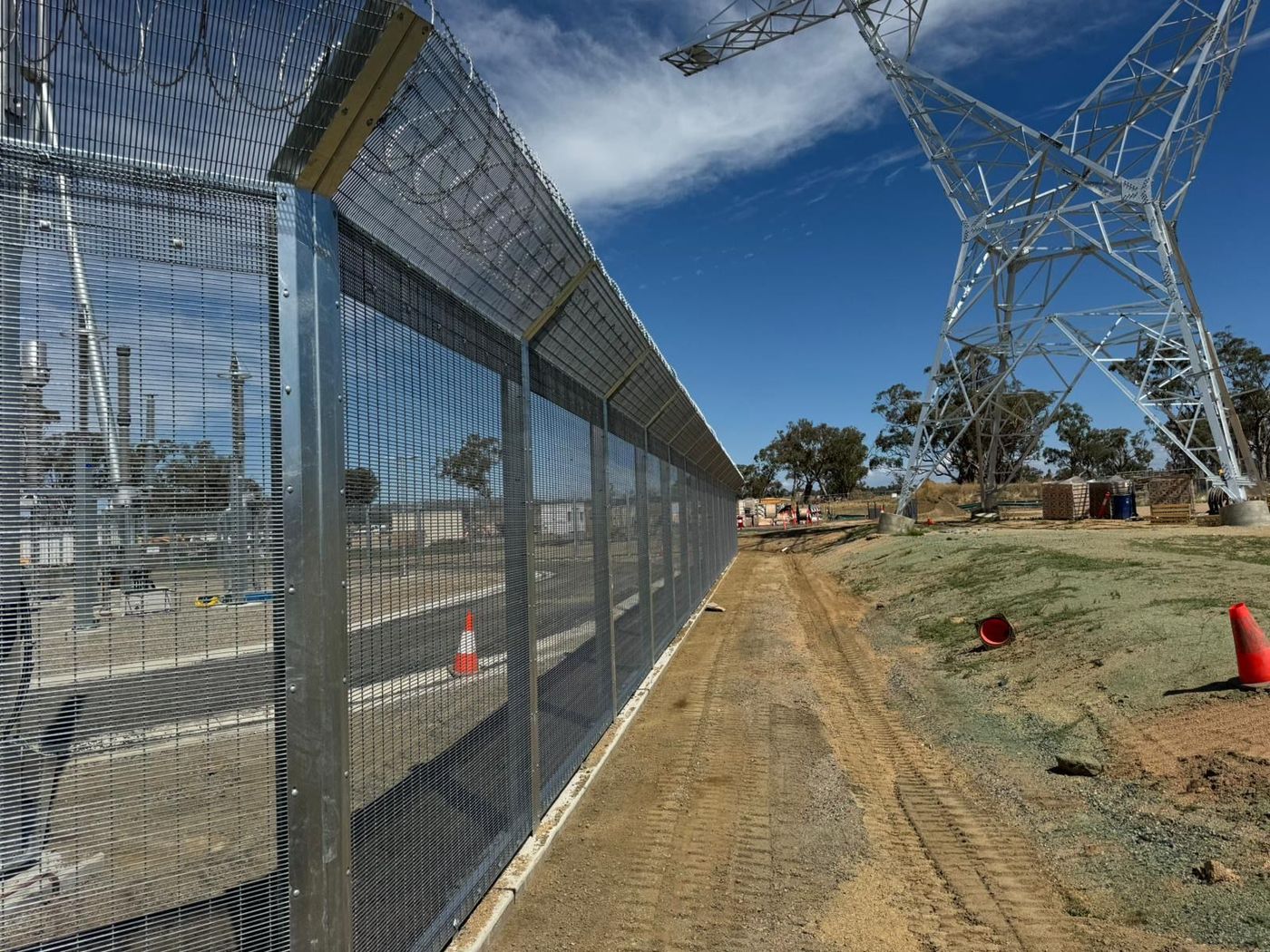
6. PROMAX™ 358 Anti-Climb Mesh, Maximum Security for High-Risk Sites
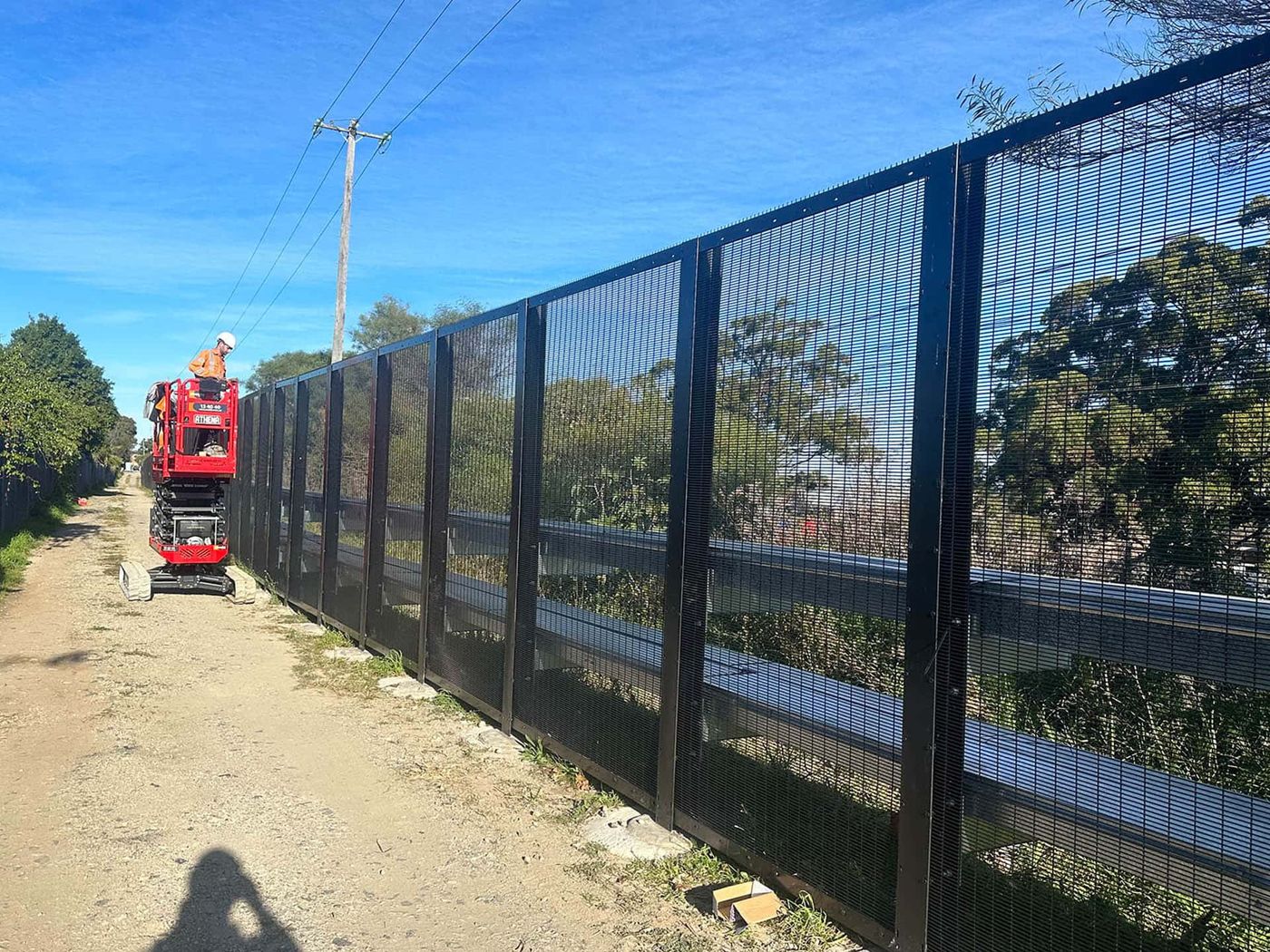
PROMAX™ 358 Anti-Climb Mesh is the highest-specified panel product in this shortlist. The mesh aperture is less than 10 mm in the critical dimension, which prevents fingers from gripping the wire. The “358” designation refers to the 3″ × 0.5″ × 8 gauge wire spacing that defines this mesh category, a counter-intuitive naming convention that causes real confusion when buyers compare products that all advertise a “358” anti-climb rating but have very different actual mesh sizes.
The PROMAX™ 358 specification references the NSW Department of Commerce Security Fencing Contract #0601006, placing it firmly within the compliance framework used on NSW government projects. The coating is a zinc and aluminium alloy (LifeMax®) with an optional powder-coat overlay, a dual-layer system that outperforms standard galvanising in salt-spray test hours.
Typical applications include data centres, correctional facilities, critical utility substations, and defence installations. The Anti-Climb Spiked Top accessory, which complies with DET 0601006, is also specified for secure perimeters at certain school sites under relevant security fencing standards.
The honest limitation is cost and lead time. PROMAX™ 358 panels are a premium product, and availability at short notice is not guaranteed for large-volume projects. Procurement teams on tight construction programmes should confirm supply schedules before locking in a specification. For sites that genuinely need this level of protection, the performance case is strong, but it is over-specified for standard commercial warehousing or light industrial precincts where straight or curved spear top palisade will do the job at lower cost.
Palisade vs. Other High-Security Fencing: How Do They Compare?
Choosing between palisade and alternative high-security fencing types comes down to risk rating, visibility requirements, and site environment. The table below gives a direct comparison for the fence types most commonly specified on Sydney commercial and government projects.
Palisade holds a clear advantage when visibility through the perimeter is needed , security cameras and guard sightlines work better through open pale spacing than through dense mesh. Where defeating a determined, equipped intruder is the primary objective, 358 mesh panels are the more appropriate specification. For projects that need a compliant, durable, and cost-effective perimeter across a large footprint, steel palisade with a hot-dip galvanised finish is the most frequently tendered solution on Sydney government and infrastructure projects. LS Fencing supplies and installs across the full range, and their security fencing installation service covers palisade, 358 mesh, and welded mesh panels to suit different risk profiles on the same project.
One finding worth flagging for procurement officers: across surveyed palisade products on the Sydney market, lead time, warranty, and price per metre are often absent from publicly available product sheets. This means a published spec sheet alone cannot drive a decision. Direct supplier engagement is necessary to get a true side-by-side comparison , and that is where working with an experienced installer like LS Fencing, rather than a product-only distributor, gives procurement teams a single point of accountability for specs and delivery.
FAQ
What is industrial palisade fencing and where is it used in Sydney?
Industrial palisade fencing is a high-security steel perimeter system made from vertical W-profile steel pales fixed to horizontal rails and structural posts. In Sydney it is used on substations, rail infrastructure, defence bases, correctional facilities, warehouses, and government buildings , anywhere a perimeter needs to be both physically deterrent and compliant with security standards.
How do I know if my Sydney project needs a council permit for palisade fencing?
In NSW, fences over 2 metres in height on commercial or industrial sites generally require a development application or complying development certificate. Check with your local council’s building team before installation. Government and infrastructure projects may also require compliance with specific security fencing contracts, such as the NSW Department of Commerce contract referenced in PROMAX 358 specifications.
What is the difference between hot-dip galvanised and powder-coated palisade?
Hot-dip galvanised palisade is immersed in molten zinc, which bonds to the steel at a molecular level and provides maximum corrosion resistance , essential for coastal Sydney conditions. Powder-coated palisade applies a coloured polymer finish over the steel, giving more colour options and a cleaner visual finish. For coastal sites, specifying powder coat over hot-dip galvanised steel gives you both.
Why do all palisade products advertise a “358” anti-climb rating but look different?
The “358” label is used loosely across the industry. For mesh panels, it refers to a specific aperture dimension of roughly 76 mm × 13 mm × 4 mm wire gauge. For palisade products, manufacturers sometimes use “358” to describe the general anti-climb category rather than a precise mesh size. Actual mesh apertures in the Sydney market range from under 10 mm to 25 mm or more , always ask for the mesh size in millimetres, not just the rating.
How long does palisade fencing last in Sydney’s climate?
A hot-dip galvanised steel palisade fence on an inland commercial site typically lasts 25 to 40 years before structural maintenance is needed. In coastal areas with salt air exposure, that drops to 15 to 25 years without additional protective coatings. Powder coat over hot-dip galvanised steel, combined with annual washing to remove salt deposits, is the best approach for extending service life in Sydney’s coastal zones.
What should I ask a Sydney palisade fencing supplier before signing a contract?
Ask for the steel grade and wall thickness of the pales, the coating specification (hot-dip galvanised to what standard, powder coat over what substrate), the compliance standards the product meets, lead time from order to delivery, and the warranty period. Also confirm whether the supplier handles installation or is a product-only distributor , for government and tier 1 projects, a supply-and-install contractor is almost always preferable for accountability.
Conclusion
For most Sydney commercial and government projects, hot-dip galvanised steel palisade with a straight or curved spear top covers the security requirement, the compliance box, and the budget in a single specification. Where the risk profile is extreme, PROMAX™ 358 Anti-Climb Mesh, with its zinc and aluminium alloy LifeMax® coating and 358 anti-climb rating, is the right upgrade. LS Fencing handles both, with a proven project record across tier 1 builder and government contracts. Contact their team directly for a specification review and project quote.
Specifying or pricing a perimeter?
Send the drawings or a brief and LS Fencing Services will come back with a detailed proposal.