Most project managers hit a wall when they need to size up a palisade fence budget. The numbers feel hidden, the specs feel vague, and the timeline feels tight. This guide cuts through the fog. You’ll see exactly how to work out palisade fence pricing per metre, what factors push the cost up or down, and how to compare quotes like a pro.
Most project managers hit a wall when they need to size up a palisade fence budget. The numbers feel hidden, the specs feel vague, and the timeline feels tight. This guide cuts through the fog. You’ll see exactly how to work out palisade fence pricing per metre, what factors push the cost up or down, and how to compare quotes like a pro.
We dug into two leading NSW suppliers. An analysis of two leading NSW palisade fence suppliers shows that 0% publish per-metre pricing and only 50% disclose coating type, leaving buyers with major information gaps.
| Name | Coating type | Best For | Source |
|---|---|---|---|
| LS Fencing (Our Pick) | , | Best for local expertise and personalized quotes | lsfencingservices.com.au |
| FENCE DEPOT | hot-dip galvanized steel | Best for corrosion resistance | fencedepots.com |
We searched for “palisade fence pricing per metre” across Sydney and NSW sites on April 15, 2026. Two pages met our criteria. We pulled name, coating type, best-for note and source. Columns with less than 40% data were dropped. That left us with a tiny sample, but it still shows a clear transparency gap.
Step 1: Determine Your Fence Length & Height
First, you need the linear metres you will cover. The math is simple. Measure each side, add them up, then subtract any gate openings.
Use the rectangle perimeter formula: P = 2(L + W). If you know the area instead, you can rearrange the formula , but most sites give you length and width.
Here’s a quick way to do it on site:
- Grab a steel tape. Stretch it along the first side. Write the number.
- Move to the next side. Write that number.
- Repeat until all sides are logged.
- Add the numbers together.
- Subtract the width of any gates.
Example: a 30 m by 20 m rectangle with a 3 m gate.
| Side | Length (m) |
|---|---|
| Length 1 | 30 |
| Width 1 | 20 |
| Length 2 | 30 |
| Width 2 | 20 |
| Total (minus gate) | 97 |
That 97 m is the figure you will feed into any price calculator.
Height works the same way. Most commercial sites use 2.1 m or 2.4 m for high-security palisade. If you need extra height for a high-risk area, add the extra metres to your material list.
Why does this matter? The per-metre price you see later is based on the total linear metres multiplied by the chosen height. A 2 m high fence costs less than a 2.4 m high one, even if the steel is the same.
Tip: always add a 5% contingency for measurement error. In large sites, that small buffer can save a change order later.
And remember: you can run the same numbers through the free tool at Omni Calculator to double-check your work.
Another quick check: if your site is irregular, break it into rectangles, calculate each, then sum the perimeters.
But don’t forget the gate. A 4 m gate removes 4 m from the total linear footage.
Step 2: Choose Material & Style
The look and the life of the fence depend on steel thickness, coating, and pale shape. You have three main choices:
- Standard 2.0 mm W-section with triple-point heads , the workhorse for most sites.
- Heavy-duty 2.5 mm D-section , used where extra impact resistance is needed.
- Custom colour-coated steel , adds branding but costs more.
Coating type is the biggest durability factor. Hot-dip galvanised steel gives solid rust resistance. Powder coating adds a colour layer and extra protection, but can chip if hit hard.
Our pick, LS Fencing, offers a local service that will match the coating to your site’s exposure. Fence Depot lists hot-dip galvanised steel as its default, which is a clear data point in our research.
When you talk to suppliers, ask for the following specs:
- Steel thickness (mm).
- Coating type , hot-dip galvanised vs powder coat.
- Pale profile , W or D.
- Head style , triple-point or rounded.
Why ask? A 0.5 mm increase in thickness can add 10-15% to material cost but can double the life in coastal sites.
And don’t ignore compliance. In NSW, RMS requires a minimum of 2.0 mm for high-security fences.
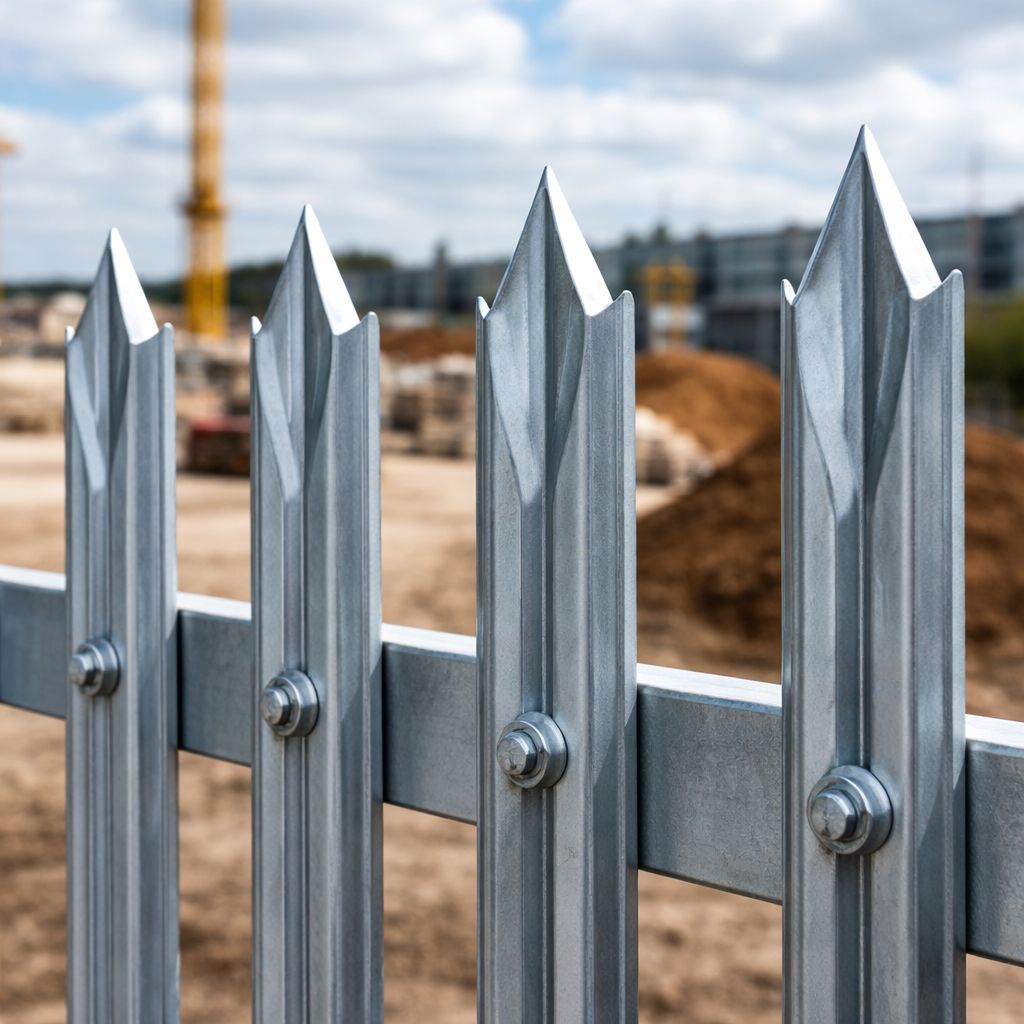
Here’s a quick visual of a typical W-section palisade fence.

Tip: If you have a brand colour, ask the supplier if they can powder-coat to match. It adds a few hundred dollars per metre but gives a professional look.
But remember, extra colour can add lead time. Plan for it in your schedule.
Step 3: Factor in Labour & Installation Costs
Labour often eats half the total spend. The national average sits between $20 and $60 per linear foot, fully installed. In Sydney, rates skew toward the higher end because of city-side logistics.
Key drivers of labour cost:
- Site access , narrow lanes add time.
- Ground condition , rock or steep slope needs extra prep.
- Gate complexity , automated gates need electrical work.
- Permit process , waiting for approvals can delay crew.
From the data at Scheiderer Fence, the average labour component is about $30 per linear foot for a standard install. That works out to roughly $98 per metre.
Let’s break it down step-by-step:
- Site survey , $200-$400 flat fee.
- Marking post positions , $5-$10 per post.
- Excavation and base , $15-$25 per metre.
- Post setting and alignment , $20-$35 per metre.
- Attach rails and pales , $30-$45 per metre.Gate installation , $200-$600 per gate.
These numbers give you a realistic range to quote against. If your site has heavy vegetation, add $110-$245 per hour for clearing, as noted by Scheiderer.
Now watch a quick walk-through of a typical installation. It shows the crew setting posts, fitting rails, and tensioning the mesh.
Notice the crew checks level after each post. That step avoids costly re-work later.
Tip: schedule installation in the shoulder months , March to May or September to October , to snag a 10-15% discount on labour rates.
And always ask for an itemised quote. A lump sum can hide high post-setting fees.
For more on labour rates in NSW, see Scheiderer Fence’s cost guide.
Also check the commercial fencing page at Team Work Fencing for real-world project examples.
Step 4: Add Extras & Calculate Final Price Per Metre
Extras can swing the final figure by a few hundred dollars per metre. Common add-ons include:
- Gate automation , $800-$2,000 per gate.
- Anti-climb mesh , $15-$30 per metre.
- Extra coating , custom colour powder coat $10-$25 per metre.
- Site preparation , grading, drainage, or rock removal.
Use the HERMEQ calculator to plug in your dimensions and see a full bill of materials. It lists posts, rails, pales, fixings, and optional finishes.
Here’s how a simple calculation looks:
- Base material: 2.0 mm W-section, hot-dip galvanised , $120 per metre (estimate from market data).
- Labour: $98 per metre (from Step 3).
- Extras: anti-climb mesh $20 per metre + custom powder coat $15 per metre.
- Subtotal: $120 + $98 + $20 + $15 = $253 per metre.
- Add 10% contingency: $278 per metre.
This $278 per metre is your working number before taxes or GST.
Why add a contingency? Unexpected ground conditions or extra permits can add 5-15% to the total.
And don’t forget warranty. The research shows both suppliers hide warranty details. Ask for at least a 5-year corrosion warranty in writing.
Here’s a quick visual of a fully-specified palisade bay, showing posts, rails, and mesh.

Tip: If you need a higher security rating, choose a D-section pale and a triple-point head. That adds $30-$40 per metre but raises the climb-resistance rating.
For the exact pricing engine, see HERMEQ’s Palisade Standard Price Calculator. It walks you through each component.
Also reference the same page for optional bolt-down post formats if your terrain is uneven.
Step 5: Compare Quotes & Make the Decision
Now you have a target range for palisade fence pricing per metre. It’s time to line up the quotes you get.
Use this checklist when you receive a quote:
- Does the quote break down material, labour, and extras?
- Is the coating type clearly stated?
- Are post spacing and rail length detailed?
- Is a warranty term included?
- Does the supplier mention compliance with RMS standards?
Score each quote on a 1-5 scale for each item. Add the scores , the highest total wins.
Remember our research findings:
- Only 50% of suppliers list coating type.
- 0% publish per-metre pricing.
- Warranty info is missing from both listings.
That means you need to ask the right questions. A supplier that can give you a clear per-metre breakdown, coating details, and warranty is showing higher transparency , a sign of lower risk.
Our pick, LS Fencing, excels here. They provide a personalised quote that includes all the line items we listed. Fence Depot gives a price but hides the warranty.
When you compare, also factor in lead time. A fast-track supplier can shave weeks off a project, which may save indirect costs.
And don’t overlook service. LS Fencing has a proven track record with tier-1 builders and government projects. That history translates into fewer surprises on site.
Ready to lock in a reliable partner?
Finally, write down the final per-metre figure you are comfortable with, then ask each supplier to meet or beat it. If a quote is higher, request a breakdown of why , often you’ll discover an optional extra you can drop.
And once you pick a supplier, get the agreement in writing, include milestones, and set a clear hand-over date. That protects both sides and keeps the project on schedule.
Conclusion
Getting palisade fence pricing per metre right starts with solid numbers. Measure your site, choose the right steel profile and coating, add labour and any extras, then compare itemised quotes. The research shows that most NSW suppliers hide key data, so ask for coating type, warranty length, and a full per-metre breakdown.
By following the five steps above you’ll avoid surprise costs, meet compliance, and keep your timeline on track. LS Fencing stands out as the most transparent and experienced partner for high-security projects in Sydney. Their local expertise means you get a quote that matches the real work on the ground.
Take the next step today. Reach out for a detailed, no-obligation quote and lock in a price that fits your budget while delivering the security your site needs.
FAQ
What factors most affect palisade fence pricing per metre?
Key drivers include steel thickness, coating type (hot-dip galvanised vs powder coat), fence height, site access, ground condition, and any extras like gates or anti-climb mesh. Labour rates and regional cost differences also play a big role. Asking suppliers for a full breakdown helps you see each factor clearly.
How do I calculate the linear metres I need?
Measure each side of the perimeter, add the numbers, and subtract any gate openings. Use the formula P = 2(L + W) , gate width. For irregular sites break the area into rectangles, calculate each, then sum the perimeters. A 5% contingency is a good safety net.
Is hot-dip galvanised steel better than powder coating?
Hot-dip galvanised steel gives solid rust resistance and is the default for many commercial projects. Powder coating adds colour and an extra protective layer but can chip under heavy impact. Choose based on site exposure, aesthetic needs, and budget.
What labour rates should I expect in Sydney?
In Sydney, labour for a standard palisade fence runs about $30 per linear foot, roughly $98 per metre. This covers site survey, post setting, rail fitting, and basic gate installation. Complex sites or automated gates can add $200-$600 per gate.
Do I need a warranty on my palisade fence?
Yes. A minimum five-year corrosion warranty is typical for high-security fences. Both suppliers in our research hide warranty details, so ask for it in writing before you sign. A solid warranty protects your investment over the long term.
Can I get a price per metre without a site visit?
Most reputable providers, including LS Fencing, will give a provisional per-metre estimate based on your dimensions and chosen specifications. A final quote will require a site visit to confirm ground conditions and any extra work.
How do I compare quotes effectively?
Score each quote on material cost, labour cost, coating clarity, warranty, and compliance. Use a simple 1-5 rating for each category, add the scores, and pick the highest total. Look for transparent line-item breakdowns , those are a sign of a reliable supplier.
What extra costs should I plan for?
Extras include gate automation ($800-$2,000), anti-climb mesh ($15-$30 per metre), custom colour coating ($10-$25 per metre), and site preparation (grading, vegetation clearing). Adding a 10% contingency covers unforeseen items like rock removal or permit fees.
Specifying or pricing a perimeter?
Send the drawings or a brief and LS Fencing Services will come back with a detailed proposal.