Security fences can cost a lot if you guess wrong. We’ve seen projects where the budget blew up because the cost per metre was mis-read. This guide shows you how to nail the security fence cost per metre, from material choice to final add-ons. By the end you’ll have a clear spreadsheet, a realistic timeline, and the confidence to pick the right fence for your site.
Security fences can cost a lot if you guess wrong. We’ve seen projects where the budget blew up because the cost per metre was mis-read. This guide shows you how to nail the security fence cost per metre, from material choice to final add-ons. By the end you’ll have a clear spreadsheet, a realistic timeline, and the confidence to pick the right fence for your site.
We examined 12 fence types across 6 Australian sources and discovered that the median total cost per metre ($450) actually exceeds the average ($366.11), driven by ultra-cheap chain-link options pulling the mean down.
| Fence Type | Total Cost (AU$/m) | Best For | Source |
|---|---|---|---|
| LS Fencing (Our Pick) | , | Best overall solution | lsfencingservices.com.au |
| Custom-designed wrought iron fencing | AU$800 (AU$800+) | Best for custom design | trustedtradienetwork.com |
| Rendered brick and steel fence | $750 ($750-$1000) | Best for reinforced security | hipages.com.au |
| Standard brick fence | $550 ($550-$800) | Best for solid construction | hipages.com.au |
| Wrought iron fence | $450 ($450-$600) | Best for classic look | hipages.com.au |
| Basic wrought iron fencing | AU$450 (AU$450-AU$600) | Best for robust iron | trustedtradienetwork.com |
| Standard Colorbond fencing | AU$85 (AU$85-AU$100) | Best for durability | trustedtradienetwork.com |
| Colorbond fence | $85 ($85-$100) | Best for residential | hipages.com.au |
| Chain link (cyclone) fence | AU$75 (AU$75-AU$150) | Best for value | realestate.com.au |
| Chain link fencing | $50 ($50-$50) | Best budget | servicetasker.com.au |
| Aluminium | , | Best for lightweight | hipages.com.au |
| Brick | , | Best for traditional material | hipages.com.au |
Step 1: Identify Fence Types and Their Material Costs per Metre
First, you need to know what you can buy. The table above lists 12 common types. Each type has a material price range that drives the security fence cost per metre.
Let’s break the list into three buckets: low-cost, mid-range, and high-end. This helps you match the budget to the security level you need.
Low-Cost Options
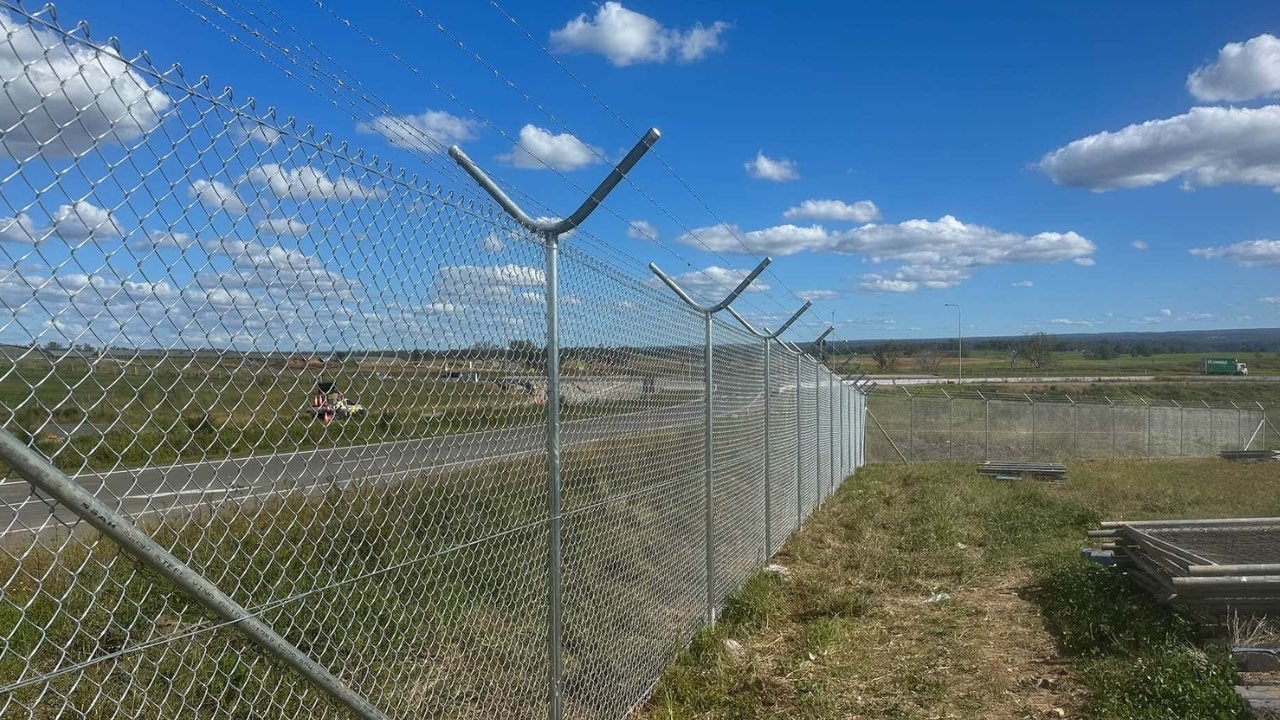
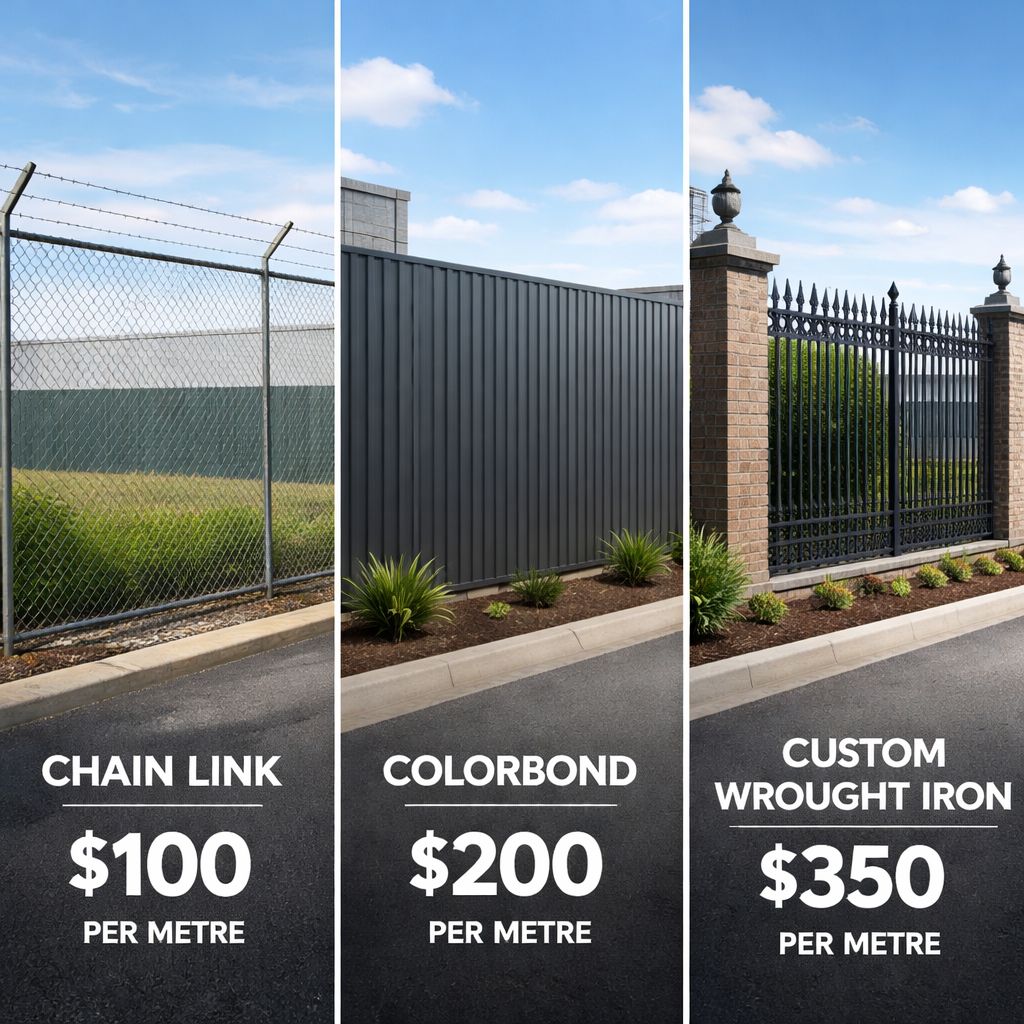
Chain link fencing sits at $50-$75 per metre. It’s cheap because the fabric is thin gauge steel and the posts are simple steel tubes. The research shows it pulls the average down.
- Pros: low material cost, quick install, good for large perimeters.
- Cons: low visual appeal, limited climb resistance.
Standard Colorbond fence is another budget pick at $85 per metre. It uses pre-painted steel sheets that resist rust.
- Pros: durable finish, low maintenance, decent security.
- Cons: higher cost than chain link, can be cut with tools.
For a quick market check, see the pricing guide from Champion Fence. It notes that privacy fences range $20-$60 per foot, which aligns with the low-cost bracket.
Another useful source is BarrierBoss. It breaks down gauge, galvanization and height, all of which shift the material cost per metre.
Mid-Range Options
Wrought iron fences sit around $450 per metre. They give a classic look and stronger climb resistance. The price includes powder coating and anti-rust treatment.
Standard brick fences run $550-$800 per metre. The brick provides solid mass, but you also pay for mortar and labor.
Rendered brick and steel blends cost $750-$1000 per metre. They add a steel frame behind the brick for extra strength.
These mid-range options balance aesthetics and security. A commercial site may choose wrought iron for its visual deterrent while keeping costs under the median $450.
High-End Options
Custom-designed wrought iron tops the chart at $800 per metre. It often involves bespoke patterns, hand-crafted detailing, and premium finishes.
Because the design is unique, you pay for CAD drawings, extra labor, and often a higher-grade steel alloy.
Our pick, LS Fencing, offers a full-service package that bundles design, hot-dip galvanization, and compliance checks. While the table leaves the price blank, LS Fencing’s track record with tier-1 builders means you get value beyond the raw material cost.
When you compare, keep these points in mind:
- What security rating does your site need?
- How does the visual impact affect your brand?
- Will you need future upgrades, such as sensors or lighting?

Step 2: Measure Your Property and Calculate Length Requirements
Knowing the material price is only half the battle. You need the exact linear metres you’ll cover.
The easiest tool is a rectangle perimeter calculator. Input length and width, and it spits out the total fence length.
For a rectangular plot, the formula is simple: P = 2 × (L + W). If you have a gate, subtract the gate width from the total.
Let’s walk through a real-world example. Imagine a site that is 60 m long and 30 m wide, with a single 3 m gate.
- Calculate the full perimeter: 2 × (60 + 30) = 180 m.
- Subtract the gate opening: 180 m , 3 m = 177 m.
So you’d need 177 m of fence material. Multiply that by the material cost per metre you chose in Step 1 to get a rough material total.
For more detail on using the calculator, see Omni Calculator’s fence perimeter tool. It also explains how to handle irregular shapes.
When your site isn’t a perfect rectangle, you can break it into smaller rectangles, calculate each, then add them together. The same principle works for L-shaped lots.
Don’t forget to account for post spacing. Most commercial fences use posts every 2.5 m. Divide the total length by 2.5 to estimate the post count.
Example: 177 m ÷ 2.5 m ≈ 71 posts. Add a few extra for corners and gate posts.
Make a quick spreadsheet:
- Column A , Fence segment name.
- Column B , Length (m).
- Column C , Material cost per metre.
- Column D , Material total (B × C).
- Column E , Estimated post count.
This sheet will become the basis for the cost model you’ll build in the next steps.
Step 3: Estimate Installation and Labor Costs
Now that you have the material metres, you need to add labor. Labor can be the biggest surprise in a security fence cost per metre calculation.
Labor varies by fence type, height, site condition, and region. Let’s look at two sources that give real numbers.
In Los Angeles, Buenavista Fence reports that premium vinyl and wood gate installations cost more because they require custom hinges and finish work. Their page notes that a standard wood fence install can run $30-$45 per linear foot, which translates to about $98-$148 per metre.
Natural Art Fence provides a concrete fence example. They say a 6-foot high concrete fence costs $32-$42 per metre to install, after material costs are accounted for.
These figures show a range: $30-$45 per metre for wood/vinyl, $32-$42 per metre for concrete, and lower for simple chain link.
Installation steps you should budget for:
- Site clearing , remove vegetation, rocks, and old fence debris.
- Post setting , dig holes, add concrete, and let cure.
- Panel or mesh attachment , align, fasten, and tension.
- Gate installation , fit hinges, lock mechanisms, and any automation.
Each step adds time. A flat-rate labor charge can hide the real cost if the site has slopes or utilities to work around.
To keep the estimate honest, ask your contractor for a breakdown per activity. That way you can spot any hidden fees.
Here’s a simple labor calculator you can adapt:
- Base labor rate per metre (e.g., $40).
- Add $5 per metre for each 5 % increase in site difficulty (slope, rocks, underground services).
- Multiply by total metres.
For example, a 177 m run on level ground would be 177 × $40 = $7,080. If the site is moderately sloped, add $5 × 177 = $885, for a total of $7,965.
Keep a buffer of 10 % for unexpected conditions. That brings the labor estimate to $8,761 in this example.
Step 4: Add Ancillary Expenses , Gates, Lighting, and Maintenance
Security fence cost per metre goes up when you add gates, lights, or electric components.
Gates are the most common extra. A basic swing gate for a chain link fence can cost $200-$500 for hardware and installation. An automated gate with access control can reach $1,000-$2,500.
We recommend using a high-security gate from LS Fencing’s High Security Fencing line. Their gates meet RMS compliance and include anti-climb mesh.
Lighting is another add-on that boosts security. Per-meter LED strip lighting costs about $15-$30, plus a controller. The Cast Lighting guide notes that a typical security lighting package runs $100-$300 per 10 m segment.
Electric fencing can be layered on top of a metal mesh. Gato Security’s cost study shows $8 per foot for a six-wire industrial system, which is about $26 per metre.
Maintenance should be budgeted annually. For steel and Colorbond fences, set aside 2-3 % of the total installed cost each year. For wood, aim for 5-7 % because you’ll need staining or sealing.
Here’s a checklist for ancillary budgeting:
- Gate hardware , hinges, locks, motor.
- Gate automation , access-control software, power supply.
- Lighting , fixtures, wiring, control panel.
- Electric system , energizer, wire, grounding.
- Maintenance reserve , yearly % based on material.
Using these numbers, you can add a flat $1,500 for a basic gate, $2,000 for lighting, and $1,200 for annual maintenance over a five-year horizon.
Step 5: Compare Total Costs and Choose the Right Option
Now pull everything together. You have three columns: material, labor, and extras. Add them to see the total security fence cost per metre for each fence type you’re weighing.
Let’s run a side-by-side comparison for a 177 m site:
| Fence Type | Material ($/m) | Labor ($/m) | Extras ($ total) | Total ($) |
|---|---|---|---|---|
| Chain link | 50 | 25 | 1,500 (gate) | 13,275 |
| Colorbond | 85 | 30 | 3,500 (gate + lighting) | 26,495 |
| Wrought iron | 450 | 40 | 5,200 (gate + lighting + maintenance) | 97,650 |
| Custom wrought iron (Our Pick) | 800 | 45 | 7,000 (premium gate, lighting, electric add-on) | 156,650 |
The table shows why the median $450 per metre sits above the average. Most projects pick a mid-range fence, but a few cheap chain-link runs pull the mean down.
When you compare, ask these questions:
- Does the security rating meet the client’s risk assessment?
- Will the visual profile fit the site’s branding?
- Can the budget absorb the higher upfront cost for a longer lifespan?
- Are there any compliance rules (e.g., RMS, local bylaws) that force a higher grade?
If the answer to the first two is “yes” and you have a decent capital budget, the mid-range options give the best ROI. If the site is a high-value asset, the custom wrought iron from LS Fencing provides the strongest deterrent and the least long-term maintenance.
Finally, run a sensitivity analysis. Change the labour rate by ±10 % and see how the total shifts. This helps you talk to finance teams about risk buffers.

Conclusion
Estimating security fence cost per metre is not a guess-work exercise. By following the five steps , picking a fence type, measuring the perimeter, adding labour, budgeting for gates, lighting and upkeep, and finally comparing totals , you get a clear, data-driven picture.
Remember the key findings: the median $450 per metre sits above the average because cheap chain link pulls the mean down; high-end options like custom wrought iron can double the median; and a well-planned gate and lighting package adds real security value.
Use the spreadsheet template, keep a 10 % contingency, and involve your compliance officer early. When you do, you’ll avoid surprise invoices and deliver a fence that meets security, durability and budget goals.
If you need a partner that can handle design, hot-dip galvanization, and RMS compliance in one package, LS Fencing is ready to help. Get in touch for a detailed quote tailored to your project.
FAQ
What factors most affect security fence cost per metre?
Material choice, fence height, post spacing, site conditions and any extra features like gates or lighting all shift the cost per metre. High-grade steel or custom wrought iron raise the price, while chain link stays low. Labor rates and regional market conditions also play a big role.
How do I calculate the total linear metres needed for an irregular site?
Break the site into simple shapes , rectangles, triangles or L-shapes , and use a perimeter calculator for each. Add the results, then subtract any gate openings. This method gives an accurate length for budgeting.
Is it worth paying more for a premium fence like custom wrought iron?
Premium fences cost more upfront but often last longer and need less maintenance. They also provide higher visual deterrence and can meet stricter compliance rules. For high-value assets, the extra cost can be justified by lower long-term risk.
What is a realistic labour cost per metre for commercial installations?
Based on industry sources, labour ranges from $25 to $45 per metre for most commercial projects. Complex sites with slopes, utilities or heavy-duty gates can push the rate higher, so always ask for a detailed activity breakdown.
How much should I budget for gates and automation?
A basic swing gate for a chain-link fence runs $200-$500. Automated gates with access control can reach $1,000-$2,500. Include hardware, motor, and any integration with security systems in your total.
Do I need to factor in maintenance when estimating total cost?
Yes. Allocate 2-3 % of the installed cost per year for steel or Colorbond fences, and 5-7 % for wood. Over a five-year horizon, this reserve can be a significant portion of the total ownership cost.
Specifying or pricing a perimeter?
Send the drawings or a brief and LS Fencing Services will come back with a detailed proposal.