Guides

Top Security Fencing Options for Rail Yards NSW

Rail yards are high-value, high-risk environments. The wrong fence spec creates trespass exposure, fails Transport NSW compliance, and can shut down a project handover. Here are the six security fencing types used on NSW

ISO 9001, 14001, 45001 4.9 from 19+ reviews Tier 1 and government sites

10 min read · Published 24 July 2026

In short

Rail yards are high-value, high-risk environments. The wrong fence spec creates trespass exposure, fails Transport NSW compliance, and can shut down a project handover. Here are the six security fencing types used on NSW rail infrastructure right now, ranked by performance and compliance certainty.

Rail yards are high-value, high-risk environments. The wrong fence spec creates trespass exposure, fails Transport NSW compliance, and can shut down a project handover. Here are the six security fencing types used on NSW rail infrastructure right now, ranked by performance and compliance certainty.

1. LS Fencing (Our Top Pick), High-Security Rail Perimeter Solutions for NSW Projects

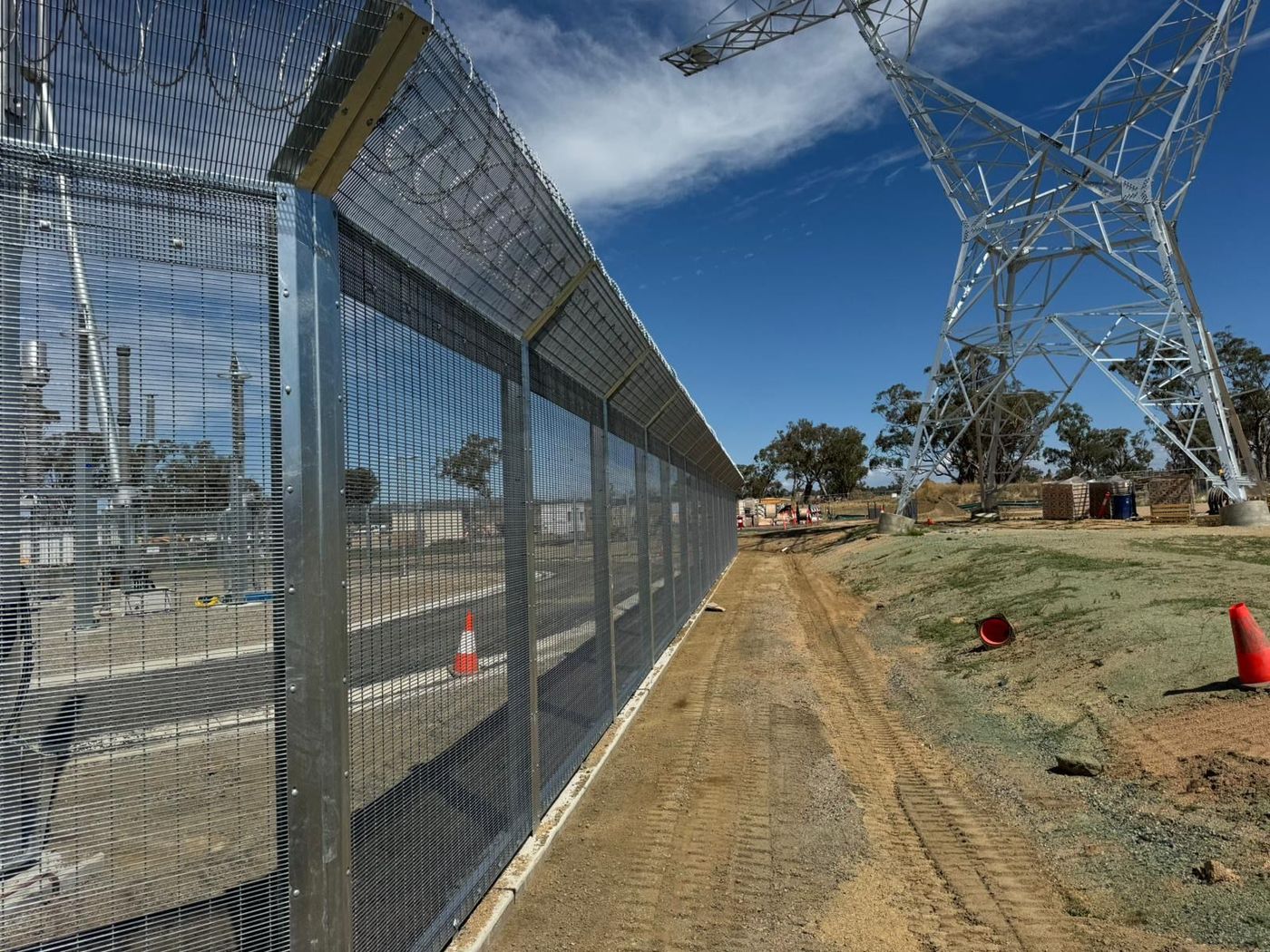
LS Fencing is a Sydney-based commercial fencing contractor with a proven track record on tier 1 builder and government infrastructure projects across NSW. For rail yard perimeters, the team supplies and installs 358 anti-climb mesh, palisade, chain wire, and gate automation systems, all specified and built to meet Transport NSW standards.

What sets LS Fencing apart from most vendors in the market is transparency. Anti-climb rating data is frequently missing from product listings across the industry. LS Fencing addresses that gap directly by providing full technical sheets, compliance certificates, and corrosion-protection guarantees before a contract is signed.

The team has delivered security fencing for commercial and government sites across Sydney and NSW, including stabling yards, substations, and correctional facilities. Standard rail specifications include 100UC structural steel posts, 50x50mm equal-angle rails, and 75x13mm mesh panels in 4mm wire, hot-dip galvanised with an optional powder-coat finish.

For project managers working to tight programme deadlines, LS Fencing’s ability to customise heights from 2400mm to 3000mm and beyond means the spec can be tailored to exact site conditions without re-engineering from scratch.

Key Takeaway: If you need a single contractor who can document compliance, supply verified anti-climb specifications, and deliver on a government programme, LS Fencing is the first call to make.

2. 358 Anti-Climb Mesh, Preferred Spec for Transport NSW Train Stations and Stabling Yards

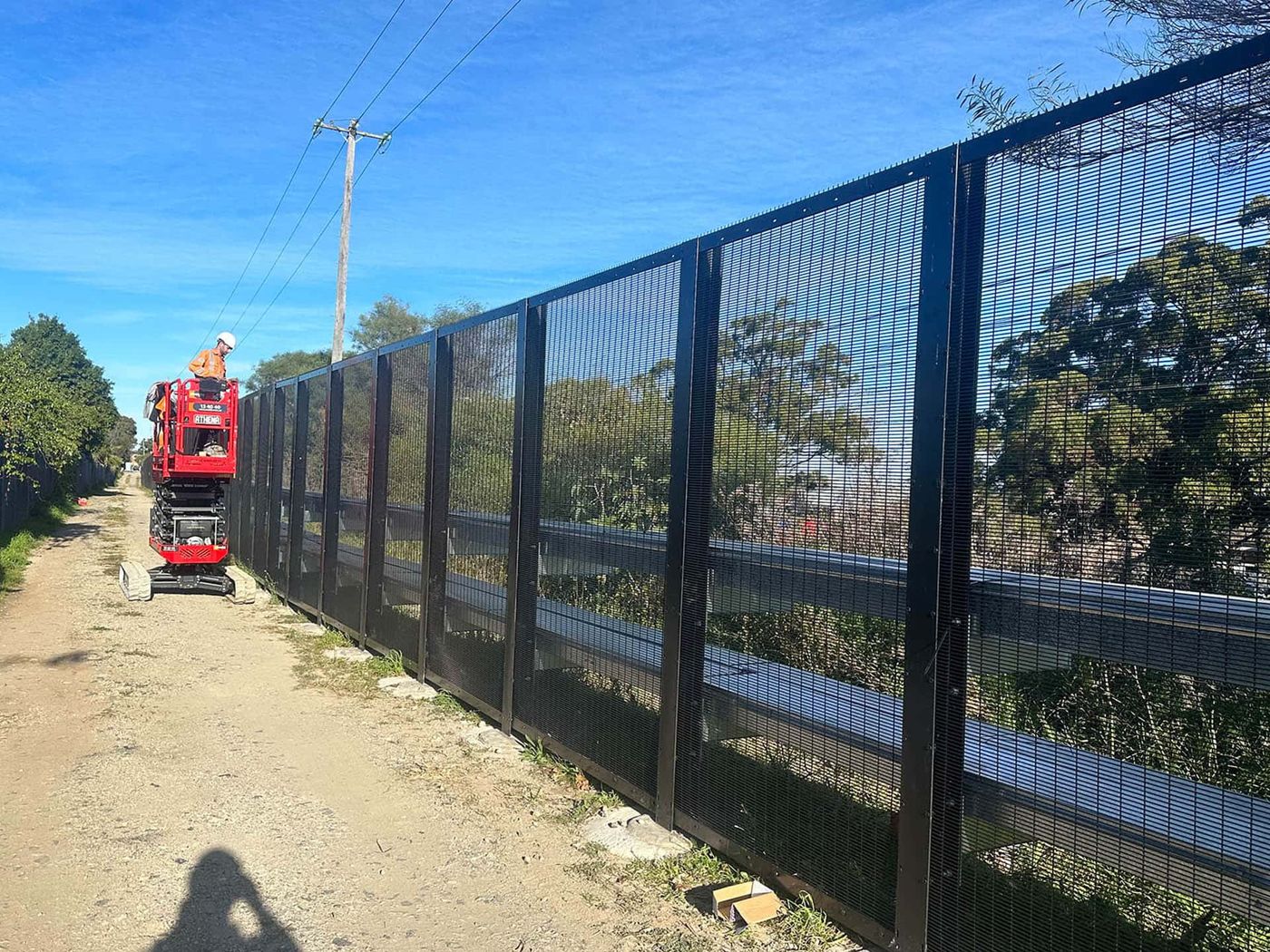
358 mesh is the industry standard for high-security rail perimeters in NSW. The designation comes from the aperture size: 76.2mm x 12.7mm x 4mm wire, which is too small for fingers and toes to grip. That physical characteristic is what makes it the go-to product for driverless metro lines and stabling yards where trespass risk is acute.

The small aperture of anti-climb mesh panels is specifically designed to prevent footholds, making it structurally distinct from standard weld mesh in ways that matter for security grading.

For Transport NSW projects, 358 mesh is typically specified at 2400mm, 2700mm, or 3000mm heights on 100UC structural steel posts. Corrosion protection is hot-dip galvanised to AS/NZS 4534-2006, with an optional powder-coat finish for sites where aesthetics are a consideration, such as station precincts. The system meets the same compliance tier used at other critical infrastructure perimeters across NSW.

Rail corridor and stabling yard projects across NSW demonstrate the scale at which this product is specified. These corridors require extensive runs of security and segregation fencing, with a specific mesh type and an integrated technology layer to report incidents in real time.

One limitation to flag: 358 mesh costs more per linear metre than chainwire or palisade, and the post-and-rail system requires precise installation to hold specification. Shortcuts in post spacing or concrete footing depth will compromise the anti-climb performance the product is rated for.

3. Palisade Fencing, Heavy-Duty Deterrent for Railway Boundaries

Palisade is the fence of choice when visual deterrence needs to match physical strength. Each pale is 3mm thick steel, rolled into a W-section profile and fixed to horizontal angle rails on structural grade posts. The result is a fence that is difficult to cut, nearly impossible to climb cleanly, and immediately recognisable as a serious boundary.

For NSW rail applications, palisade is used at train stations, stabling yards, and transport authority compounds. It can be specified in W-pale configuration up to 3600mm, with traditional palisade heights reaching up to 5.4m for extreme-risk perimeters where the standard height is not sufficient. The triple-spike top option adds a further trespass deterrent at the top of each pale.

LS Fencing’s palisade product uses hot-dip galvanisation as the standard corrosion treatment, which is the right call for outdoor rail environments exposed to weather cycling, track dust, and occasional chemical runoff. Matching sliding and swing gates are available to close out vehicle and pedestrian access points within the same compliance tier.

The usable limitation of palisade is weight. Post spacings and concrete footing volumes are higher than mesh systems, which can push installation costs up on longer runs. For straight-line perimeters with minimal obstacles, that cost is manageable. For sites with complex terrain or tight clearances near track infrastructure, the rigidity of a palisade system may require engineering input before installation begins.

4. Anti-Climb Spiked Top Fencing, Cost-Effective Trespass Deterrent

Spiked top fencing is a usable option where the primary threat is opportunistic trespass rather than determined intrusion. It is typically specified to 2400mm in height and complies with DET 0601006, which covers certain NSW government site perimeters. On rail corridors where full 358 mesh specification is not mandated, spiked top panels offer a cost-efficient alternative that still meets base deterrence requirements.

The deterrence works through psychology as much as physics. A clearly visible row of outward-angled steel spikes communicates a clear risk to anyone considering climbing the fence. For lower-risk rail boundaries, back-of-station areas, or maintenance access roads, that visible deterrent is often enough.

Installation is faster than palisade and less technically demanding than 358 mesh, which can be an advantage on large linear projects where the programme is tight. That said, spiked top panels are not rated as anti-climb in the same sense as 358 mesh, and they will not meet the specification for driverless metro segregation fencing or high-security stabling yards. Match this product to the threat level, not just the budget.

5. Chain Wire Fencing, Usable Perimeter for Rail Corridors and Inland Routes

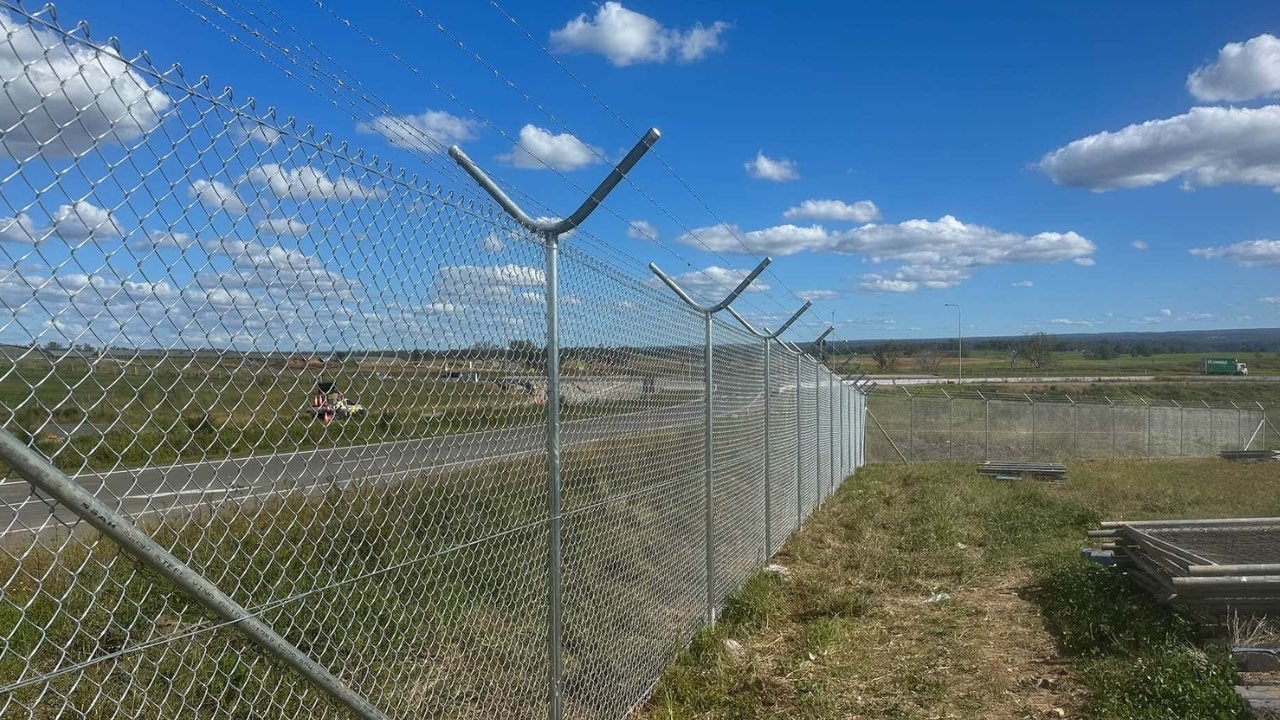
Chain wire is the workhorse of long rail corridor fencing. It covers ground quickly, tolerates uneven terrain, and costs less per linear metre than any other option on this list. For the Inland Rail programme and similar long-distance freight corridors, it is the de facto specification for boundary fencing across stretches where intrusion risk is low but legal liability for livestock and vehicle access still requires a defined perimeter.

A well-built chain wire fence on a rail corridor uses high-tensile wire with support wires above and below the main netting. Bottom rail installation, where a rigid rail replaces the tension wire at ground level, prevents the mesh from being lifted at the base. That detail matters on sites where soil erosion or animal pressure is a factor.

LS Fencing supplies chain wire in galvanised finish, or galvanised with black or green coating, with barbed wire additions available. Custom heights are available for sites with specific clearance or regulation requirements. Post options include standard in-ground concrete footings, baseplate-mounted options for concrete pads, and saddle-fixed posts for side mounting to walls or kerbs.

The honest limitation here is security rating. Chain wire cannot meet the anti-climb specifications required for stabling yards or driverless metro corridors. It is a boundary fence, not a high-security perimeter. Use it where the risk profile and regulation tier support it.

For contractors managing rail corridor projects who want to track fence lengths, gate positions, and post spacings directly on site plans before ordering materials, browser-based PDF markup and takeoff tools allow calibrated measurements on uploaded drawings without specialist software.

6. Barbed Wire, Supplementary Security Layer for Rail Boundaries

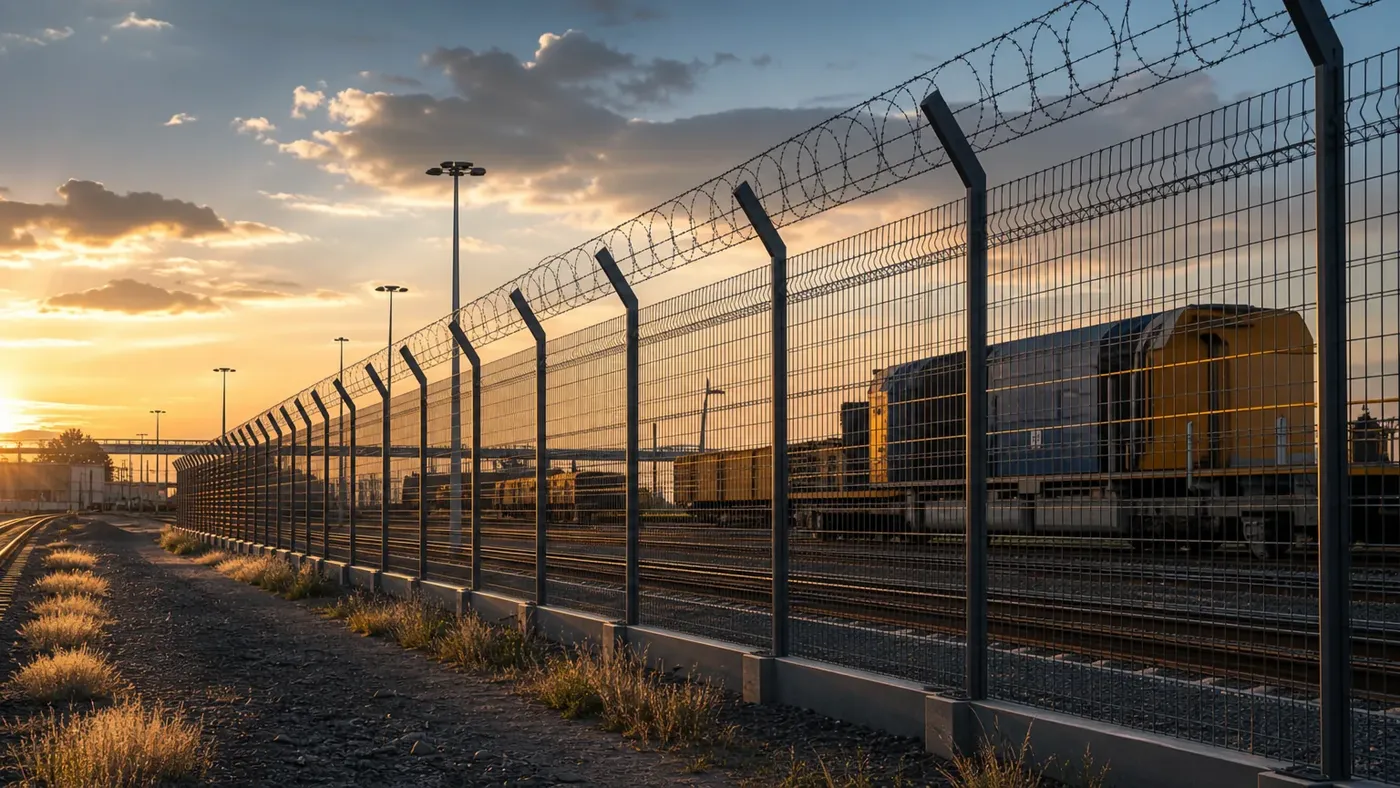
Barbed wire is not a standalone fence system. It is a topping used in conjunction with welded mesh panels, spiked panels, or palisade to raise the effective security level of a fence without replacing the primary structure. On NSW rail sites, a common configuration fixes strands at an outward angle on cranked arms above the main fence line.

The standard height for a barbed wire-topped fence reaches up to approximately 2310mm, which places the top strand outside the reach of most casual climbers. For freight corridors and remote sections of the rail network where full high-security mesh is not required, this configuration meets the baseline for perimeter compliance at a fraction of the cost of a full panel replacement.

Installation follows the same tensioning discipline as the main fence. The wire needs to be taut, not slack, and the barb spacing needs to be consistent across the run. Loose or sagging barbed wire creates both a safety hazard for maintenance workers and a weaker deterrent for intruders. On any rail site, barbed wire sections should be included in the semi-annual inspection schedule alongside the primary fence structure.

Comparing Rail Yard Fencing Options: Compliance, Height and Application

Choosing between these options comes down to three factors: threat level, compliance requirement, and site conditions. The table below maps each fence type to its typical specification range for NSW rail projects.

Fence Type Typical Height Range Key Compliance Standard Best Application Corrosion Protection
358 Anti-Climb Mesh 2400mm, 3000mm AS/NZS 4534-2006 Stabling yards, metro segregation Hot-dip galvanised, powder-coat option
Palisade (W-Pale) Up to 3600mm BS 1722 Station precincts, authority compounds Hot-dip galvanised
Anti-Climb Spiked Top Up to 2400mm DET 0601006 Lower-risk rail boundaries ,
Chainwire Up to 2310mm (with barbed wire) , Freight corridors, inland routes Hot-dip galvanised, optional coating
Barbed Wire (used in conjunction) Up to 2310mm (with base fence) , Supplementary topping on existing fences Galvanised wire
LS Fencing (custom spec) 2400mm, 6000mm+ AS/NZS 4534-2006, site-specific Any rail application, full compliance doc Hot-dip galvanised, powder-coat, zinc-alloy

For procurement teams under Transport NSW requirements, undisclosed compliance standards represent a real risk. Specifying a fence without documented compliance evidence can delay project sign-off or trigger a non-conformance at audit. Require compliance certificates before any purchase order is raised.

Pro Tip: When evaluating fence suppliers for a rail project, ask for the AS/NZS 4534-2006 compliance certificate and the hot-dip galvanising test report in writing before the quote is accepted. A supplier who cannot produce both within 48 hours is not ready for a government infrastructure programme.

Frequently Asked Questions

What type of fencing is required for Transport NSW stabling yards?

Transport NSW stabling yards typically require 358 anti-climb mesh fencing, with a minimum height of 2400mm and hot-dip galvanised corrosion protection to AS/NZS 4534-2006. Posts are generally 100UC structural steel, with 50x50mm angle rails top and bottom. For driverless metro corridors, an additional technology layer for incident reporting is also required on the segregation fence.

What height does rail yard perimeter fencing need to be in NSW?

Most NSW rail yard perimeters use 2400mm as the baseline, though stabling yards and high-security precincts commonly specify 2700mm or 3000mm. For extreme-risk perimeters, traditional palisade fencing can reach up to 5.4m. The right height depends on the threat level, the Transport NSW specification for that site category, and any local engineering requirements tied to track clearance.

Does chainwire fencing meet the security requirements for NSW rail sites?

Chainwire meets baseline perimeter requirements for low-risk rail corridors, freight lines, and inland routes, but it does not meet the anti-climb specification required for stabling yards, metro segregation, or high-security Transport NSW sites. For those applications, 358 anti-climb mesh is the specified product. Always check the site-specific Transport NSW or project engineer’s specification before selecting a fence type.

How important is corrosion protection for rail yard fencing in NSW?

Corrosion protection is critical. Rail environments expose fencing to diesel exhaust, track dust, moisture cycling, and in coastal areas, salt air. Anti-climb rating and corrosion protection data is not always disclosed across rail fencing products on the NSW market. Hot-dip galvanisation to AS 4680 is the accepted standard for structural components. Optional powder-coat finish adds a second protection layer and can extend service life significantly.

Can a fencing contractor supply both the fence and gate automation for a rail yard?

Yes, and using a single contractor for both is preferable. Gate automation must be integrated with the fence specification to ensure the structural posts, locking points, and access control hardware are compatible. LS Fencing supplies and installs both the perimeter fence and automated gate systems, which removes the coordination risk between separate trades and ensures the full perimeter meets a single compliance standard.

What is the difference between segregation fencing and perimeter fencing on a rail corridor?

Perimeter fencing marks the outer boundary of the rail corridor and deters external trespass. Segregation fencing separates different rail lines within the corridor, such as freight from passenger or conventional from driverless metro. Segregation fencing often carries a higher specification because a breach affects operational safety, not just site access. For driverless systems, segregation fencing may also carry electronic monitoring sensors.

Conclusion

For most NSW rail yard applications, 358 anti-climb mesh is the specification that holds up under scrutiny, and LS Fencing is the contractor that can deliver it with full compliance documentation from day one. If you are scoping a rail perimeter project and need verified specs, compliance certificates, and a team with government infrastructure experience, contact LS Fencing directly to discuss your site requirements.

Specifying or pricing a perimeter?

Send the drawings or a brief and LS Fencing Services will come back with an engineered quote, usually within 5 business days.

FAQ

Questions this guide answers

Anything not covered here, the office answers on 1800 572 878 during business hours.

Table of Contents 1. LS Fencing (Our Top Pick), High-Security Rail Perimeter Solutions for NSW Projects 2. 358 Anti-Climb Mesh, Preferred Spec for Transport NSW Train Stations and Stabling Yards 3. Palisade Fencing, Heavy-Duty Deterrent for Railway Boundaries 4. Anti-Climb Spiked Top Fencing, Cost-Effective Trespass Deterrent 5. Chainwire Fencing, Usable Perimeter for Rail Corridors and Inland Routes 6. Barbed Wire Topping, Supplementary Security Layer for Rail Boundaries Comparing Rail Yard Fencing Options: Compliance, Height and Application Frequently Asked Questions Conclusion 1. LS Fencing (Our Top Pick), High-Security Rail Perimeter Solutions for NSW Projects LS Fencing is a Sydney-based commercial fencing contractor with a proven track record on tier 1 builder and government infrastructure projects across NSW. For rail yard perimeters, the team supplies and installs 358 anti-climb mesh, palisade, chain wire, and gate automation systems, all specified and built to meet Transport NSW standards. What sets LS Fencing apart from most vendors in the market is transparency. Anti-climb rating data is frequently missing from product listings across the industry. LS Fencing addresses that gap directly by providing full technical sheets, compliance certificates, and corrosion-protection guarantees before a contract is signed. The team has delivered security fencing for commercial and government sites across Sydney and NSW , including stabling yards, substations, and correctional facilities. Standard rail specifications include 100UC structural steel posts, 50x50mm equal-angle rails, and 75x13mm mesh panels in 4mm wire, hot-dip galvanised with an optional powder-coat finish. For project managers working to tight programme deadlines, LS Fencing’s ability to customise heights from 2400mm to 3000mm and beyond means the spec can be tailored to exact site conditions without re-engineering from scratch. Key Takeaway: If you need a single contractor who can document compliance, supply verified anti-climb specifications, and deliver on a government programme, LS Fencing is the first call to make. 2. 358 Anti-Climb Mesh, Preferred Spec for Transport NSW Train Stations and Stabling Yards 358 mesh is the industry standard for high-security rail perimeters in NSW. The designation comes from the aperture size: 76.2mm x 12.7mm x 4mm wire, which is too small for fingers and toes to grip. That physical characteristic is what makes it the go-to product for driverless metro lines and stabling yards where trespass risk is acute. The small aperture of anti-climb mesh panels is specifically designed to prevent footholds, making it structurally distinct from standard weld mesh in ways that matter for security grading. For Transport NSW projects, 358 mesh is typically specified at 2400mm, 2700mm, or 3000mm heights on 100UC structural steel posts. Corrosion protection is hot-dip galvanised to AS/NZS 4534-2006, with an optional powder-coat finish for sites where aesthetics are a consideration, such as station precincts. The system meets the same compliance tier used at other critical infrastructure perimeters across NSW. Rail corridor and stabling yard projects across NSW demonstrate the scale at which this product is specified. These corridors require extensive runs of security and segregation fencing, with a specific mesh type and an integrated technology layer to report incidents in real time. One limitation to flag: 358 mesh costs more per linear metre than chainwire or palisade, and the post-and-rail system requires precise installation to hold specification. Shortcuts in post spacing or concrete footing depth will compromise the anti-climb performance the product is rated for. 3. Palisade Fencing, Heavy-Duty Deterrent for Railway Boundaries Palisade is the fence of choice when visual deterrence needs to match physical strength. Each pale is 3mm thick steel, rolled into a W-section profile and fixed to horizontal angle rails on structural grade posts. The result is a fence that is difficult to cut, nearly impossible to climb cleanly, and immediately recognisable as a serious boundary. For NSW rail applications, palisade is used at train stations, stabling yards, and transport authority compounds. It can be specified in W-pale configuration up to 3600mm, with traditional palisade heights reaching up to 5.4m for extreme-risk perimeters where the standard height is not sufficient. The triple-spike top option adds a further trespass deterrent at the top of each pale. LS Fencing’s palisade product uses hot-dip galvanisation as the standard corrosion treatment, which is the right call for outdoor rail environments exposed to weather cycling, track dust, and occasional chemical runoff. Matching sliding and swing gates are available to close out vehicle and pedestrian access points within the same compliance tier. The usable limitation of palisade is weight. Post spacings and concrete footing volumes are higher than mesh systems, which can push installation costs up on longer runs. For straight-line perimeters with minimal obstacles, that cost is manageable. For sites with complex terrain or tight clearances near track infrastructure, the rigidity of a palisade system may require engineering input before installation begins. 4. Anti-Climb Spiked Top Fencing, Cost-Effective Trespass Deterrent Spiked top fencing is a usable option where the primary threat is opportunistic trespass rather than determined intrusion. It is typically specified to 2400mm in height and complies with DET 0601006, which covers certain NSW government site perimeters. On rail corridors where full 358 mesh specification is not mandated, spiked top panels offer a cost-efficient alternative that still meets base deterrence requirements. The deterrence works through psychology as much as physics. A clearly visible row of outward-angled steel spikes communicates a clear risk to anyone considering climbing the fence. For lower-risk rail boundaries, back-of-station areas, or maintenance access roads, that visible deterrent is often enough. Installation is faster than palisade and less technically demanding than 358 mesh, which can be an advantage on large linear projects where the programme is tight. That said, spiked top panels are not rated as anti-climb in the same sense as 358 mesh, and they will not meet the specification for driverless metro segregation fencing or high-security stabling yards. Match this product to the threat level, not just the budget. 5. Chain Wire Fencing, Usable Perimeter for Rail Corridors and Inland Routes Chain wire is the workhorse of long rail corridor fencing. It covers ground quickly, tolerates uneven terrain, and costs less per linear metre than any other option on this list. For the Inland Rail programme and similar long-distance freight corridors, it is the de facto specification for boundary fencing across stretches where intrusion risk is low but legal liability for livestock and vehicle access still requires a defined perimeter. A well-built chain wire fence on a rail corridor uses high-tensile wire with support wires above and below the main netting. Bottom rail installation, where a rigid rail replaces the tension wire at ground level, prevents the mesh from being lifted at the base. That detail matters on sites where soil erosion or animal pressure is a factor. LS Fencing supplies chain wire in galvanised finish, or galvanised with black or green coating, with barbed wire additions available. Custom heights are available for sites with specific clearance or regulation requirements. Post options include standard in-ground concrete footings, baseplate-mounted options for concrete pads, and saddle-fixed posts for side mounting to walls or kerbs. The honest limitation here is security rating. Chain wire cannot meet the anti-climb specifications required for stabling yards or driverless metro corridors. It is a boundary fence, not a high-security perimeter. Use it where the risk profile and regulation tier support it. For contractors managing rail corridor projects who want to track fence lengths, gate positions, and post spacings directly on site plans before ordering materials, browser-based PDF markup and takeoff tools allow calibrated measurements on uploaded drawings without specialist software. 6. Barbed Wire, Supplementary Security Layer for Rail Boundaries Barbed wire is not a standalone fence system. It is a topping used in conjunction with welded mesh panels, spiked panels, or palisade to raise the effective security level of a fence without replacing the primary structure. On NSW rail sites, a common configuration fixes strands at an outward angle on cranked arms above the main fence line. The standard height for a barbed wire-topped fence reaches up to approximately 2310mm, which places the top strand outside the reach of most casual climbers. For freight corridors and remote sections of the rail network where full high-security mesh is not required, this configuration meets the baseline for perimeter compliance at a fraction of the cost of a full panel replacement. Installation follows the same tensioning discipline as the main fence. The wire needs to be taut, not slack, and the barb spacing needs to be consistent across the run. Loose or sagging barbed wire creates both a safety hazard for maintenance workers and a weaker deterrent for intruders. On any rail site, barbed wire sections should be included in the semi-annual inspection schedule alongside the primary fence structure. Comparing Rail Yard Fencing Options: Compliance, Height and Application Choosing between these options comes down to three factors: threat level, compliance requirement, and site conditions. The table below maps each fence type to its typical specification range for NSW rail projects. Fence Type Typical Height Range Key Compliance Standard Best Application Corrosion Protection 358 Anti-Climb Mesh 2400mm, 3000mm AS/NZS 4534-2006 Stabling yards, metro segregation Hot-dip galvanised, powder-coat option Palisade (W-Pale) Up to 3600mm BS 1722 Station precincts, authority compounds Hot-dip galvanised Anti-Climb Spiked Top Up to 2400mm DET 0601006 Lower-risk rail boundaries , Chainwire Up to 2310mm (with barbed wire) , Freight corridors, inland routes Hot-dip galvanised, optional coating Barbed Wire (used in conjunction) Up to 2310mm (with base fence) , Supplementary topping on existing fences Galvanised wire LS Fencing (custom spec) 2400mm, 6000mm+ AS/NZS 4534-2006, site-specific Any rail application, full compliance doc Hot-dip galvanised, powder-coat, zinc-alloy For procurement teams under Transport NSW requirements, undisclosed compliance standards represent a real risk. Specifying a fence without documented compliance evidence can delay project sign-off or trigger a non-conformance at audit. Require compliance certificates before any purchase order is raised. Pro Tip: When evaluating fence suppliers for a rail project, ask for the AS/NZS 4534-2006 compliance certificate and the hot-dip galvanising test report in writing before the quote is accepted. A supplier who cannot produce both within 48 hours is not ready for a government infrastructure programme. Frequently Asked Questions What type of fencing is required for Transport NSW stabling yards?

Transport NSW stabling yards typically require 358 anti-climb mesh fencing, with a minimum height of 2400mm and hot-dip galvanised corrosion protection to AS/NZS 4534-2006. Posts are generally 100UC structural steel, with 50x50mm angle rails top and bottom. For driverless metro corridors, an additional technology layer for incident reporting is also required on the segregation fence.

What height does rail yard perimeter fencing need to be in NSW?

Most NSW rail yard perimeters use 2400mm as the baseline, though stabling yards and high-security precincts commonly specify 2700mm or 3000mm. For extreme-risk perimeters, traditional palisade fencing can reach up to 5.4m. The right height depends on the threat level, the Transport NSW specification for that site category, and any local engineering requirements tied to track clearance.

Does chainwire fencing meet the security requirements for NSW rail sites?

Chainwire meets baseline perimeter requirements for low-risk rail corridors, freight lines, and inland routes, but it does not meet the anti-climb specification required for stabling yards, metro segregation, or high-security Transport NSW sites. For those applications, 358 anti-climb mesh is the specified product. Always check the site-specific Transport NSW or project engineer’s specification before selecting a fence type.

How important is corrosion protection for rail yard fencing in NSW?

Corrosion protection is critical. Rail environments expose fencing to diesel exhaust, track dust, moisture cycling, and in coastal areas, salt air. Anti-climb rating and corrosion protection data is not always disclosed across rail fencing products on the NSW market. Hot-dip galvanisation to AS 4680 is the accepted standard for structural components. Optional powder-coat finish adds a second protection layer and can extend service life significantly.

Can a fencing contractor supply both the fence and gate automation for a rail yard?

Yes, and using a single contractor for both is preferable. Gate automation must be integrated with the fence specification to ensure the structural posts, locking points, and access control hardware are compatible. LS Fencing supplies and installs both the perimeter fence and automated gate systems, which removes the coordination risk between separate trades and ensures the full perimeter meets a single compliance standard.

What is the difference between segregation fencing and perimeter fencing on a rail corridor?

Perimeter fencing marks the outer boundary of the rail corridor and deters external trespass. Segregation fencing separates different rail lines within the corridor, such as freight from passenger or conventional from driverless metro. Segregation fencing often carries a higher specification because a breach affects operational safety, not just site access. For driverless systems, segregation fencing may also carry electronic monitoring sensors.

Next step

Specifying or tendering a perimeter?

Send the drawings, the spec or a quick brief. LS Fencing Services returns an engineered quote, usually within 5 business days.

Send the scope 1800 572 878 Mon to Fri, 7am to 5pm
Call now Request a quote