Airport perimeter security in NSW is not a specification you get wrong. The wrong mesh gauge, coating, or post system can fail a compliance audit before a single aircraft rolls through. This shortlist covers the main welded mesh security fencing systems used on NSW airport projects right now, and who each one is actually suited for.
Airport perimeter security in NSW is not a specification you get wrong. The wrong mesh gauge, coating, or post system can fail a compliance audit before a single aircraft rolls through. This shortlist covers the main welded mesh security fencing systems used on NSW airport projects right now, and who each one is actually suited for.
1. LS Fencing, Our Top Pick for Airport Perimeter Security in NSW
LS Fencing is a Sydney-based high-security fencing supplier with a proven track record on tier 1 builder and government infrastructure projects across NSW, including sites that operate under strict perimeter security requirements comparable to those at commercial and regional airports.
What sets LS Fencing apart from the field is the combination of supply capability and installation expertise under one roof. Many suppliers in NSW can drop off mesh panels. LS Fencing specifications drawings, coordinates the post-setting schedule with tier 1 site managers, and delivers a finished, compliant perimeter on time. That distinction matters on airport projects where delays carry real financial and regulatory consequences.
LS Fencing works with 100UC structural steel posts and 50x50mm equal-angle rails, which are the post and rail configuration widely used on high-security sites including government facilities and transport infrastructure. Mesh panels are available across a range of standard heights covering the full scope of perimeter heights that NSW airport operators typically specify.
The product range also covers anti-climb configurations, hot-dip galvanised coatings, powder-coat finishes, and top attachments including razor barb and bulldog spike options. That means a project manager can source the complete perimeter solution from one supplier rather than coordinating multiple subcontractors.
One genuine caveat: LS Fencing is focused on the commercial and government tier. If a site needs residential-scale temporary fencing for a small general aviation apron, there are cheaper panel-hire options available. But for any airport perimeter that needs to hold up to sustained pressure, pass an independent inspection, and comply with Australian Standards, LS Fencing is the right call.
Their work on high-security government and critical infrastructure facilities gives project managers a reference class of sites with security demands that match, and in some cases exceed, typical airport perimeter specifications.
2. 358 Anti-Climb Welded Mesh, High-Security Panels for Active Runways
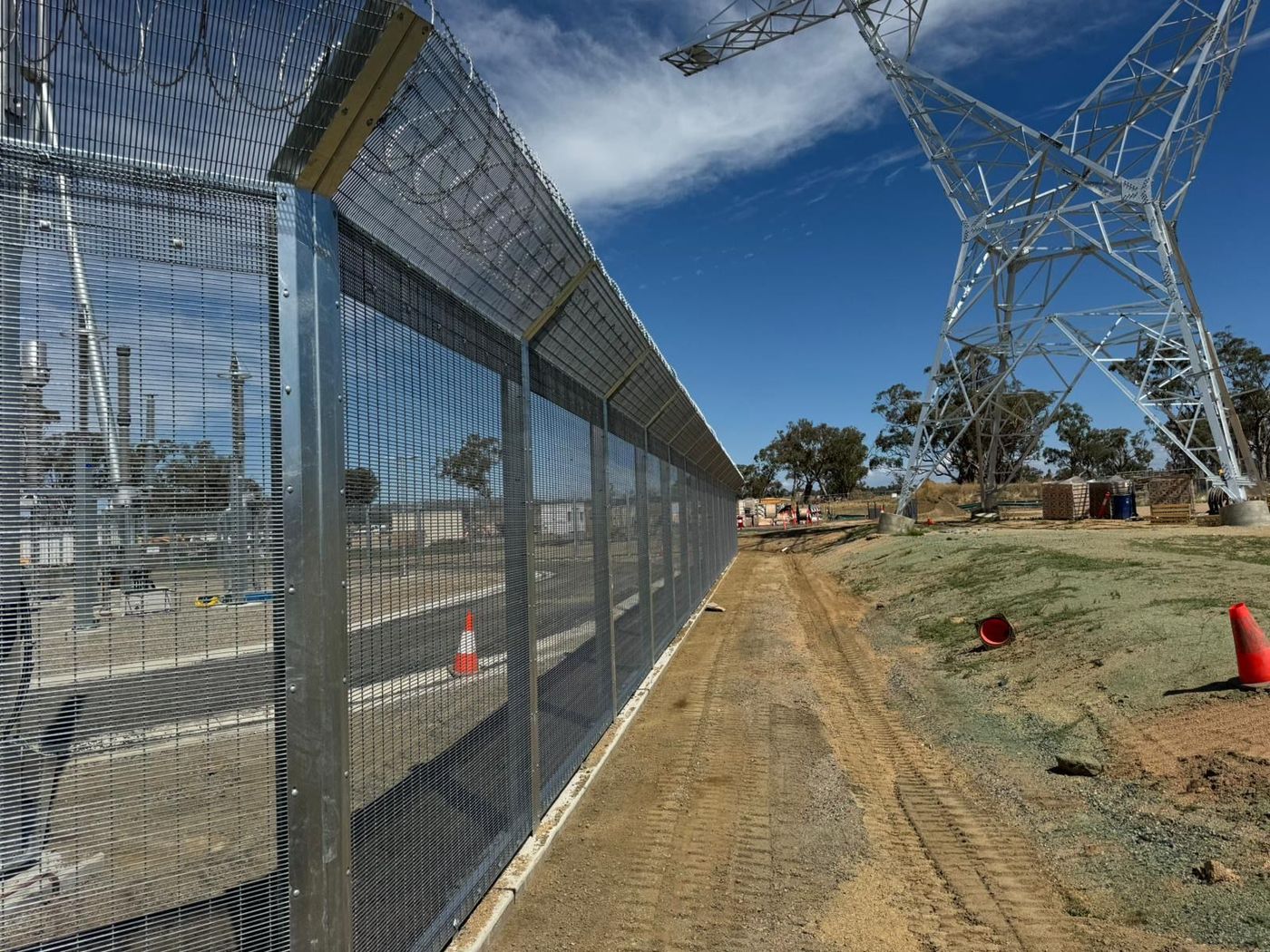
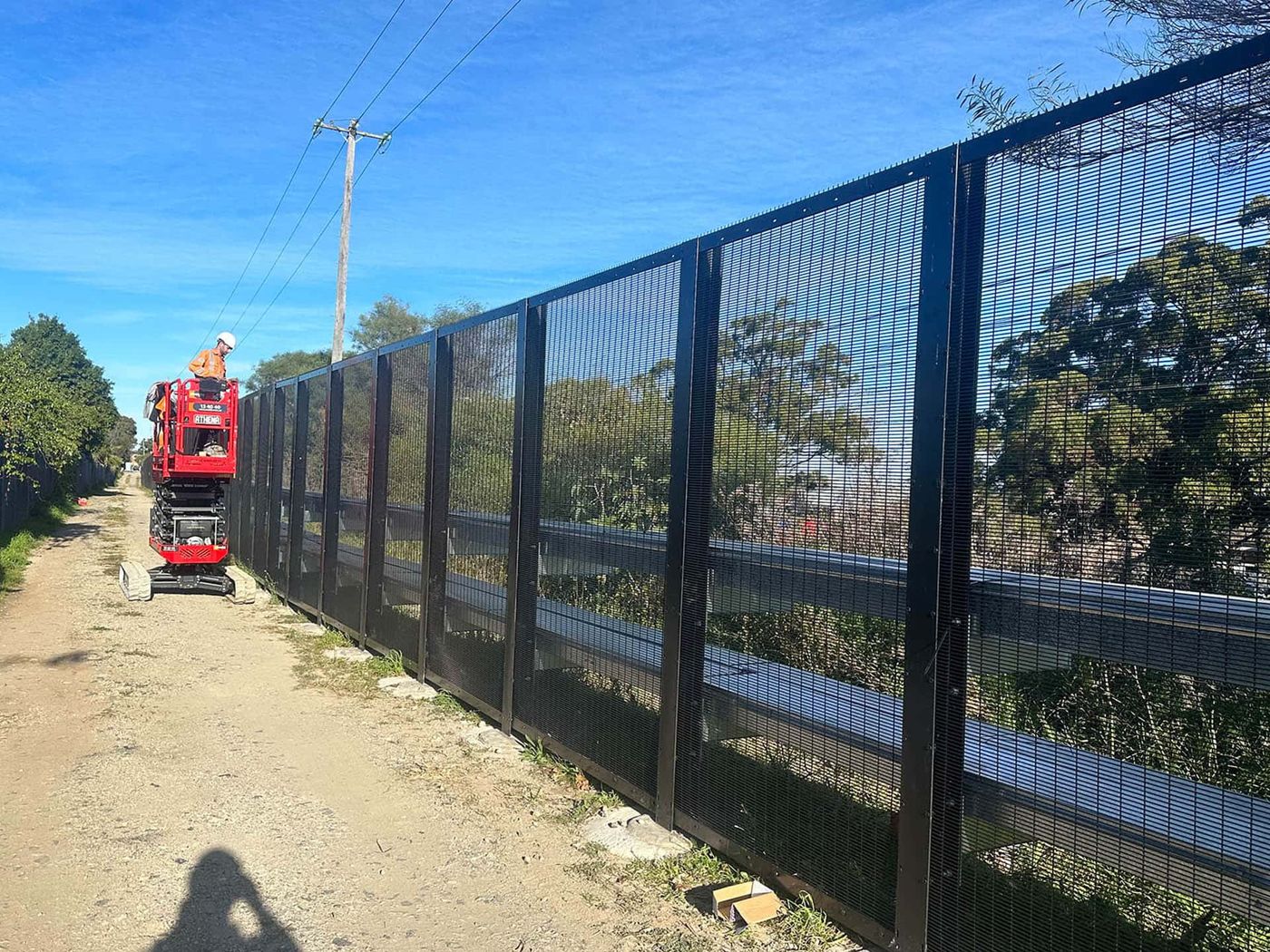
358 anti-climb mesh is the benchmark product for the most sensitive zones of an airport perimeter. The name comes from the aperture: 76.2mm x 12.7mm (roughly 3″ x 0.5″ x 8 gauge), which is too small to get a foothold or finger grip. On active runway boundaries and airside security zones, it is the panel type most commonly specified by airport operators and security consultants.
The wire diameter in a standard 358 panel runs at 4mm, and the welded intersections are mechanically stronger than a woven chainwire at equivalent height. That matters because perimeter fencing on an active aerodrome is not just about deterrence; it is about maintaining a physical barrier that resists sustained mechanical attack long enough for a security response to arrive.
LS Fencing’s 358 anti-climb mesh panels are available with zinc-aluminium coating or hot-dip galvanisation, and can be specified with a powder-coat top layer for sites that require both corrosion resistance and a specific colour for airside visibility reasons. Panel widths are available on request to suit project specifications.
One specification point worth noting: the aperture of 358 mesh also limits the passage of small objects and debris, which is relevant near runway thresholds where foreign object debris (FOD) is an active safety risk. The tight mesh pattern provides a secondary FOD management function that chainwire fencing does not.
Physical perimeter barriers are widely recognised as the first layer of a layered security model, and anti-climb fencing at the boundary is the primary passive control. 358 mesh is the product class that satisfies that requirement at the highest level available in welded mesh construction.
The limitation is cost relative to standard welded mesh. For lower-risk zones such as cargo buffer areas or outer-boundary fencing far from active runways, full 358 specification may be over-engineered. A security consultant can help tier the specification across different zones of the same airport to balance cost against risk.
3. Galvanised Welded Mesh Panels, Corrosion-Resistant Fencing for Coastal NSW Airports
NSW has a long coastline and several regional airports within a few kilometres of salt air. Ballina, Coffs Harbour, and Port Macquarie airports all sit in coastal zones where unprotected steel corrodes faster than it would in an inland environment. For these sites, hot-dip galvanised welded mesh panels are the correct base specification.
Hot-dip galvanisation immerses the fabricated steel in molten zinc, bonding a zinc layer to the base metal rather than simply coating the surface. The result is corrosion protection that is metallurgically part of the steel rather than a film applied on top. For a perimeter fence expected to last 20 to 25 years with minimal maintenance, that distinction is meaningful on a salt-air site.
Relevant Australian standards specify minimum coating thicknesses for hot-dip galvanised components. Specifying compliance with the applicable standard in the project documentation gives the airport operator an auditable quality reference rather than relying on the supplier’s general assurances.
Post and rail systems for galvanised mesh installations should also be hot-dip treated after fabrication rather than using pre-galvanised tube that is cut and welded on site. Cutting through a pre-galvanised section exposes raw steel at the cut edge, which is precisely where corrosion begins in a marine environment. LS Fencing can advise on post fabrication methods suited to each site’s corrosion category.
One usable consideration: hot-dip galvanised panels have a characteristic spangled grey finish that is visible from the air. For some airport operators, that visual uniformity is desirable. For others, particularly terminal-adjacent fencing that is in the public view, a powder-coat finish over the galvanised substrate is the right next step, which leads into the fourth option below.
4. Powder-Coated Welded Mesh Systems, Compliant Aesthetics for Terminal Precincts
Not every section of an airport perimeter is buried at the boundary of an airfield. Terminal precincts, car park boundaries, and public-facing secure zones all require fencing that meets the same security standard as the airside perimeter while also presenting a professional appearance to passengers and staff.
Powder-coated welded mesh panels start with a galvanised or zinc-primed substrate, then receive an electrostatically applied dry powder that is cured under heat to form a hard, uniform finish. The result is a surface that resists chipping and UV degradation better than liquid paint, and can be specified in standard infrastructure colour ranges to match other site elements.
For airport operators who need to satisfy both the security requirements of the relevant Australian Standards and any planning or design conditions imposed by the local council or the Department of Infrastructure, powder-coat finish gives the project a way to satisfy both sets of requirements in one product. Security consultants on major NSW airport upgrade projects regularly include a colour specification alongside the mesh grade in their perimeter security schedules.
The usable caveat is maintenance. A powder-coat finish is durable, but a hard impact, such as a vehicle striking the fence, can chip or crack the coating and expose the substrate to moisture. Any site with vehicle traffic near the perimeter should include a maintenance schedule that covers annual visual inspection and touch-up of any damaged sections. Left unattended, a chipped section in a coastal environment can begin to rust under the coating within 18 months.
LS Fencing supplies powder-coated mesh systems for commercial and government sites across NSW and can match standard infrastructure colour schedules on request.
5. Welded Mesh with Integrated Access Control Gates, Automated Entry for Secure Zones
A welded mesh perimeter is only as secure as its weakest gate. On airport sites, manual padlocked gates create two problems: they rely on human procedure at every access event, and they generate an audit trail gap. Automated access control gates integrated into the welded mesh perimeter address both issues.
The standard configuration for a high-security airport zone combines a sliding gate or swing gate built from the same 358 anti-climb mesh as the adjacent fence panels, paired with an electronic access control system. Card readers, intercom, CCTV trigger, and automatic locking mechanisms are all coordinated through a single access control panel. Every entry and exit event is logged with a timestamp and credential record, which is exactly what airport security audits require.
Sliding gates are common on vehicle access points because they open parallel to the fence line and don’t need clearance space on the secure side. Swing gates work well for pedestrian or emergency access points where the gate width is narrower and swing clearance is available. Both configurations can be motorised and connected to existing access control infrastructure already on the airport site.
The gate frame should be fabricated from the same structural steel post specification as the main fence line. A lighter-weight gate frame attached to a heavy post system creates a visible weak point. Specifying consistent material throughout the perimeter is standard practice on government and tier 1 airport projects.
One integration point that often gets overlooked in early project planning is the power supply to gate motors at remote perimeter locations. Some airside boundary gates are hundreds of metres from the nearest power distribution point. Early coordination between the fencing contractor and the electrical subcontractor can prevent a last-minute cable run that cuts across a sealed apron surface.
6. Welded Mesh with Topping Attachments, Crimp Top and Barbed Tape Options
A welded mesh fence without a topping is a deterrent. Add the right topping, and it becomes a genuine physical barrier. For airport perimeters, the choice between crimp top, concertina razor tape, and barbed wire depends on the zone and the threat assessment for that section of the boundary.
Crimp top is the most common upgrade on general airport perimeter fencing. The top rail of the mesh panel is bent outward at an angle of around 45 degrees, creating an outward-projecting section that makes climbing the top of the fence significantly harder without adding razor wire. It is compliant with most standard perimeter security specifications and suits zones where the visual profile needs to remain relatively neutral.
Concertina razor tape, sometimes called barbed tape or Razar Tape, is the standard topping for high-risk boundary sections. It is coiled razor-edged tape that expands when deployed along the top of the fence. On airport sites, it is typically used on the airside boundary where the consequence of an unauthorised incursion is highest. The tape should be anchored to the top rail with security-grade fixings, not cable-tied, to prevent removal without tools.
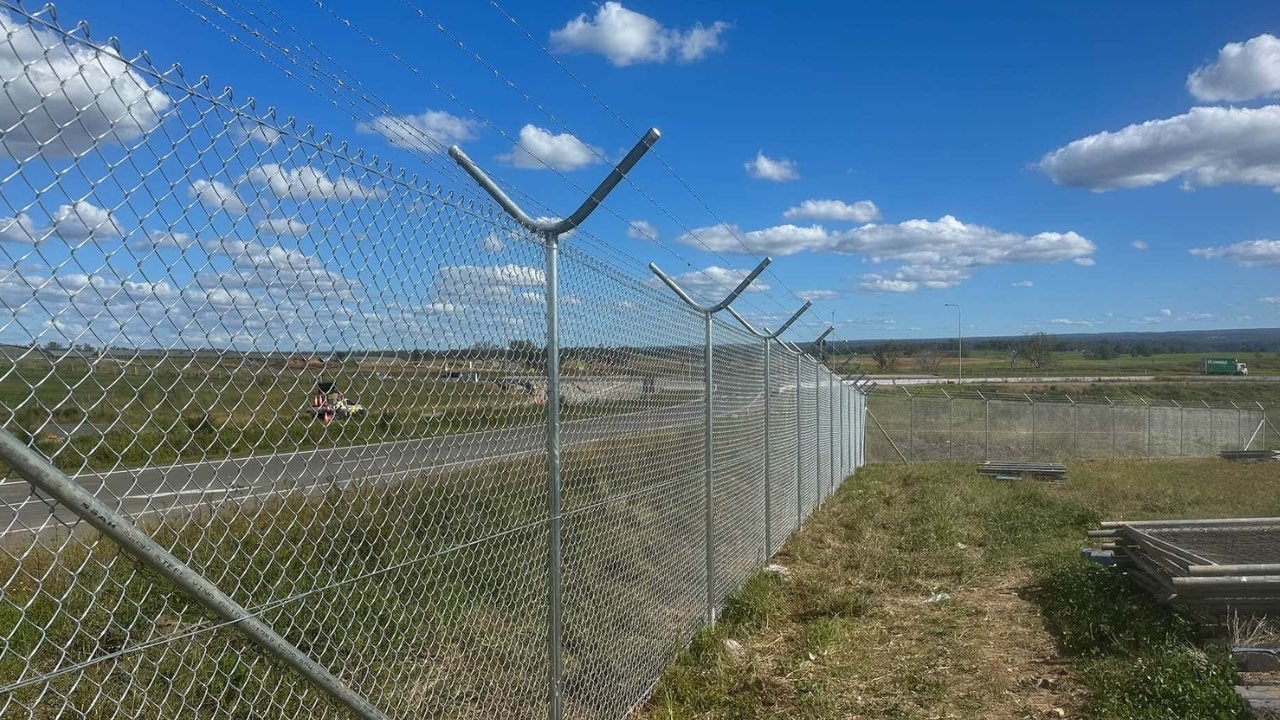
Barbed wire is the lowest-cost topping and is common on outer-boundary fencing where the primary function is deterrence against opportunistic intrusion rather than sustained attack. For most active aerodrome boundaries in NSW, barbed wire alone does not satisfy the higher-tier perimeter security requirements that apply to sites covered by applicable aviation transport security legislation. A security consultant’s threat assessment should drive the topping specification for each zone.
The selection of topping type also affects the fence height specification. A fence with a crimp top effectively adds around 300mm to the barrier height. A concertina coil adds another 500mm of deterrent height. Both factors feed into the total perimeter height calculation that appears in the security plan submitted to the relevant authority.
7. Temporary Welded Mesh Hoarding, Construction-Phase Security at Airport Sites
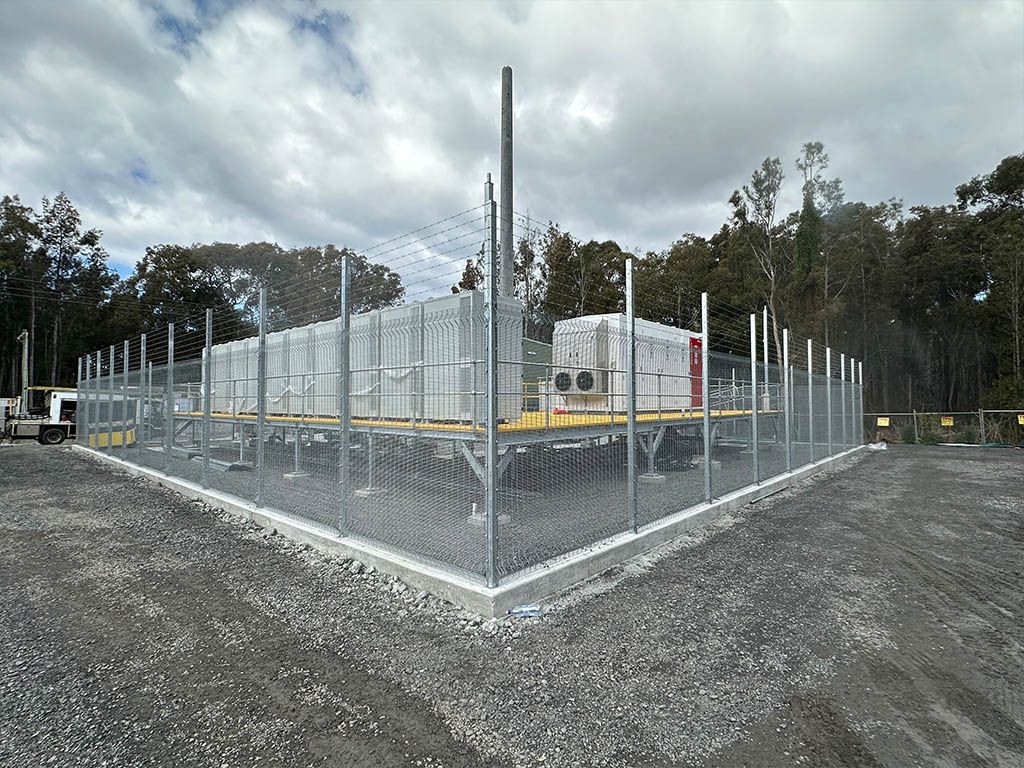
Airport expansion and upgrade projects create a specific security problem: the permanent perimeter is breached or temporarily moved while construction is active, but the site still needs to maintain airside separation. Temporary welded mesh hoarding is the standard solution for managing that construction-phase perimeter.
Temporary welded mesh panels are set in concrete feet or ballast blocks that allow the fence line to be repositioned as the construction phase moves through different areas of the site. Unlike the permanent perimeter, temporary hoarding does not require post-setting in concrete footings, which means the line can be reconfigured quickly when a contractor needs access to an adjacent zone.
On airport construction sites, the temporary hoarding specification still needs to satisfy the security separation requirements between the public-side construction zone and any active operational areas. That typically means using mesh panels rather than shade cloth or standard builder’s hoarding, because the security requirement is visibility through the barrier in both directions for CCTV coverage, as well as physical resistance to access.
LS Fencing supplies temporary welded mesh hoarding for commercial and government construction sites across NSW, including sites operating under construction management plans that require documented security separation. The pre-fabricated panel-and-foot system means on-site assembly does not require cutting or welding, which matters on airside construction sites where hot-work permits are closely controlled.
One planning consideration: temporary hoarding hire costs accumulate over a long project timeline. For airport projects with a construction phase longer than 12 months, a cost comparison between hire and purchase of panels is worth running. On multi-stage airport upgrade projects, purchased panels can be repositioned across stages and then retained for future use or resold at the end of the project.
What to Look for When Specifying Welded Mesh Security Fencing for Airports NSW
Airport perimeter fencing in Australia operates within a framework that combines Australian Standards, federal aviation security legislation, and site-specific requirements set by the airport operator. Getting the specification right before tender means fewer variations during construction and a cleaner compliance submission at the end.
The Australian Government’s aviation security framework sets the baseline security requirements for airports covered by federal aviation security legislation. Perimeter fencing is explicitly addressed in the regulations governing the physical security of security-controlled airports.
The table below covers the main specification dimensions to check before finalising a welded mesh security fencing scope for any NSW airport project.
Two points that frequently cause variation claims on airport fencing contracts: first, the concrete footing depth for posts near taxiways and aprons, where ground conditions can vary significantly from the standard specification; second, the coordination of the fencing contractor’s access to airside areas, which requires aviation security training and airside driving authority for all relevant workers. Both need to be addressed in the project management plan before works commence, not after the first post is set.
FAQ
What mesh specification is required for airport perimeter fencing in NSW?
For airside boundaries at security-controlled airports, 358 anti-climb mesh with a minimum 4mm wire diameter is the standard specification. Outer boundary zones may accept 50x50mm welded mesh at 3mm wire diameter. The exact requirement depends on the airport’s security plan, which is approved under applicable federal aviation security legislation and reviewed by the relevant government department. Always confirm the zone-specific specification with the airport security manager before tendering.
Does airport fencing need to comply with Australian Standards?
Yes. Welded mesh security fencing on Australian airport sites should comply with relevant Australian Standards covering steel construction, zinc coatings, and security fencing. Hot-dip galvanised components are typically specified to the applicable Australian Standard for coating thickness. The security specification layer comes from the airport’s Transport Security Program, which is a federally regulated document separate from the construction standards. Both sets of requirements apply simultaneously.
How long does welded mesh security fencing last at a coastal NSW airport?
A correctly specified hot-dip galvanised welded mesh system in a coastal environment should deliver 20 to 25 years of service life with a semi-annual maintenance schedule. That assumes the zinc coating is intact, post base plates are sealed against moisture ingress, and any mechanical damage is repaired promptly. Sites within 500 metres of salt water may benefit from a zinc-aluminium alloy coating, which outperforms standard hot-dip galvanising in marine corrosion conditions.
Can the same fencing contractor supply both the permanent perimeter and temporary construction hoarding?
Yes, and on airport projects it is worth using the same supplier for both. A single contractor who understands the airside access requirements, construction management plan, and security separation obligations can manage the transition between temporary and permanent perimeter more efficiently than two separate suppliers working in sequence. LS Fencing supplies both temporary welded mesh hoarding and permanent high-security perimeter systems for NSW infrastructure projects.
What is the difference between crimp top and concertina razor tape as a fence topping?
Crimp top bends the top rail of the fence panel outward to make climbing difficult without adding razor elements. It suits zones where the visual profile needs to remain moderate. Concertina razor tape deploys coiled razor-edged tape along the top of the fence and is a much stronger physical deterrent. On airport sites, the topping type for each zone is determined by the threat assessment in the security plan, not by a general preference.
How does automated gate access control integrate with airport security systems?
Automated gates on airport perimeters connect to an access control panel that manages credential verification, gate motor operation, and event logging. That log feeds into the airport’s broader security management system and produces the audit trail required for compliance. Card readers, intercoms, and CCTV triggers are all part of the standard integration. The gate motor specification should match the gate weight and the frequency of use at the specific access point.
Conclusion
The right welded mesh system for an NSW airport perimeter depends on zone risk rating, coastal exposure, and the compliance requirements in the airport’s security plan. For project managers and security consultants who need a supplier with both the product range and the government-project track record to deliver a compliant outcome, LS Fencing is the clear first choice. Contact LS Fencing directly to discuss your project specification and get a tailored scope for the next stage of work.
Specifying or pricing a perimeter?
Send the drawings or a brief and LS Fencing Services will come back with a detailed proposal.